| Author |
 Topic Search Topic Search  Topic Options Topic Options
|
chk4tix 
Guest


Joined: April 06 2007
Location: Texas
Status: Offline
Points: 4320
|
 Post Options Post Options
 Thanks(0) Thanks(0)
 Quote Quote  Reply Reply
 Topic: High Phosphates & other Tank Problems Topic: High Phosphates & other Tank Problems
Posted: December 19 2011 at 7:36pm |
quick version: High p04, increased algae growth, unable to resolve. looking for outside assistance.
*warning long post*
For almost two years, I have been battling with my tank. I have lost thousands in coral and livestock. I have almost thrown in the towel many times, but when I think of how much I have invested and how much I really love my tank when everything is “workingâ€, I just can’t bring myself to do it (yet). So I am coming here to post my situation to see if anyone can help me identify what is happening. I need to get an outside eye on this problem because there must be something I am missing. I am going try to be as detailed as possible in order to eliminate the obvious (at least to me) problems.
History:
I had a 120g tank for about 5 years and I had amazing growth, no real issues at all. Then after moving into my new home and living there a little over a year, my tank still continued to do very well. In my new home, my system consisted of my 120g display, 75g frag tank, and 40g sump all interconnected. Because I had the extra room, I decided to upgrade to a 150g tank.
During this upgrade, the only thing that changed was the amount of water (30g more), PVC rock stands, and Utah sand (which I have never used before and wonder if ultimately it is my problem). I set up my new tank and cycled the sand and water. After everything was cycled, a month or so later, I connect the new systems to my current system and let everything equalize. I ran it like this for another week and once everything had leveled out, I transferred all my corals/rock/fish in to the new tank. I kept both the 120g and the 150g up and running for about another week and then disconnected the 120g. All seemed fine until about a month later I had a major tank crash... ( Original post found here March 2010 ) At the time I thought I it was all due to the faulty pH probe, but after replacing that I still continued to run in to problems on and off. A few months later (about 2 weeks after I took pictures for my Tank of the Month Oct 2010) my tank crashed again and I lost almost all my corals/fish again. ( this was just the start )
Tanks:
My current system consists of a 150g display, a 75g frag, 46g Anemone/holding tank, and a 75g sump. All of my tanks are connected so I only have to worry about one water mass.
Lighting:
I run an 8 Bulb ATI Sunpower on the DT, an 8 Bulb TEK on the FT, a 150w mh on the 46g tank. On the sump I run two 120w twisty bulbs. The DT light has dawn/dusk from 9am-9pm and daylight’s are on from 12pm-7pm. The FT light has dawn/dusk from 8pm-5am and daylight’s are on from 9pm-4pm. The 46g is on from 4am-10am. The sump lights are on from 1am-9pm.
Equipment:
Display: 150g Standard
Display Lighting: ATI Sunpower 8x80w
Frag Tank: 60â€Lx12â€Hx24â€w
Frag Lighting: Tek 8 -54w bulb t5
Sump: 75g standard
Sump Lighing 24W Spiral Bulb DIY
Skimmer: SRO XP-3000
Water treatment: RO DI
Co2 regulator: AquariumPlants.com's Electronic Co2 Regulator
Ca Reactor: Georeef 6x18
Kalk Reactor: Georeef
Controller: APEX controller w/Vortech controller, 3 ES8, multiple probes, and lunar module.
Return Pump: Reeflo Barracuda 4500gmh
Power heads: 3 Vortech MP40ES’s
UV Sterilizer: 9x Turbo Twist.
Current water parameters (as of today):
SG 1.026
Ca 420
Alk 7.0 dKh (kept lower because currently carbon dosing)
Temp 76-75deg
pH 8.15-8.25
p04 .70ppm (down from 1.05ppm)
ammonia 0ppm
nitrates 0ppm
nitrites 0ppm
Problem:
Continued water quality issues causing fish/coral losses and increased algae growth. I believe that my problems are caused by high p04 which may be leaching from my sand bed. My sand is Utah sand, but I wonder if the sand I collected could be contaminated. I thoroughly washed and cleaned the sand before putting it in the tank but I wonder if it is just "bad sand".
Even though my system is one large water mass, there seems to be different ecosystems going on. In my display I have plenty of livestock to keep algae to a minimum, but my SPS do not extent like they do in my Frag tank. Also corals in my Frag tank grow twice as fast as in my display. However, the algae in my Frag tank has taken over and no matter what I do I can not get ahead of the algae. I have tried extra snails, fish, nudi's, but they have all died because they wont touch the algae.
I have replaced my ph, orp, and temp sensors just in case they were giving me false readings. I also purchased a larger skimmer to help remove biomass from the water. I have gone extended periods without lights and removed algae by hand on a daily basis, but again no luck.
I also purchased a Hanna p04 meter because all my previous tests said I had not p04's and I knew this couldn't be the case with all the algae. From this tester, I have come to the belief that all of my issues may be a result of the high p04 (but i guess it could be something else)
I have also removed racks and scrubbed them to remove algae but it just grows back in a matter of weeks.
I have replaced all the bulbs in case color shift was causing problems.
For the last few months I have begun carbon dosing because I have read that also helps control algae but I do not see the reduction as I have read about.
Tank Pictures (as per Mark's request):
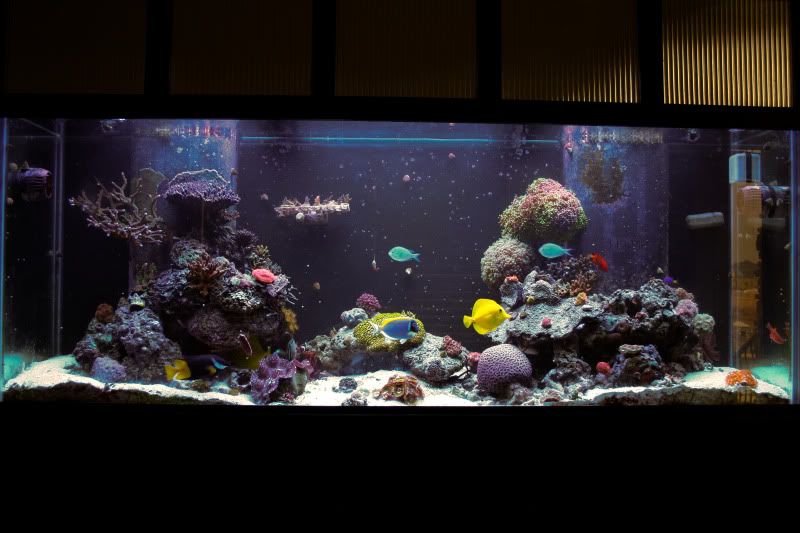
Display - Current picture:
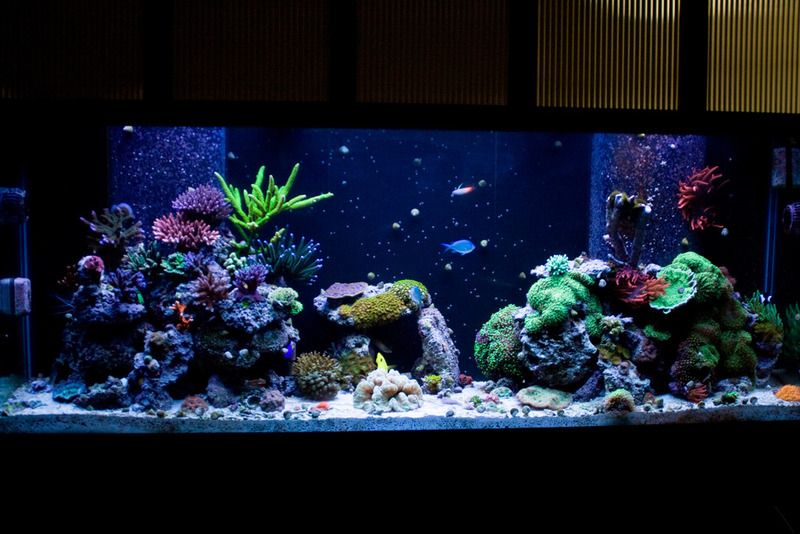
Shortly before the crash Oct 2010:
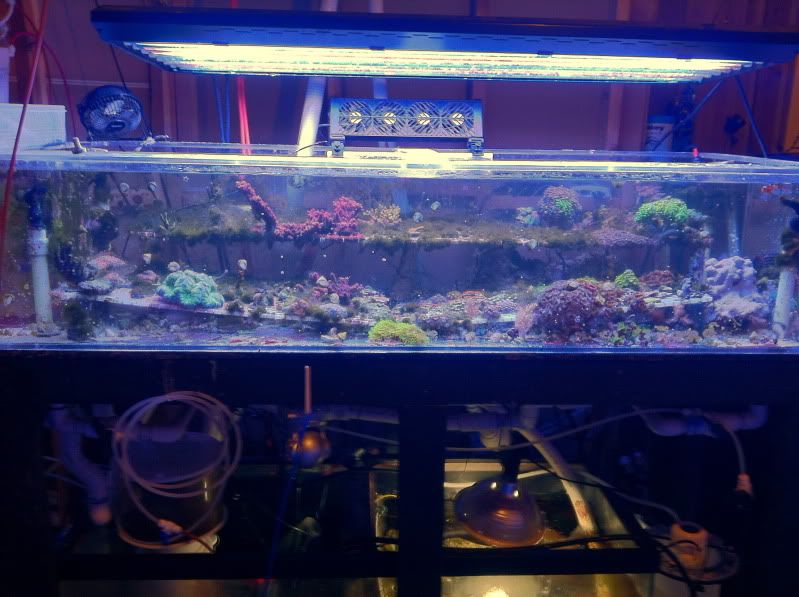
Frag - Current picture:
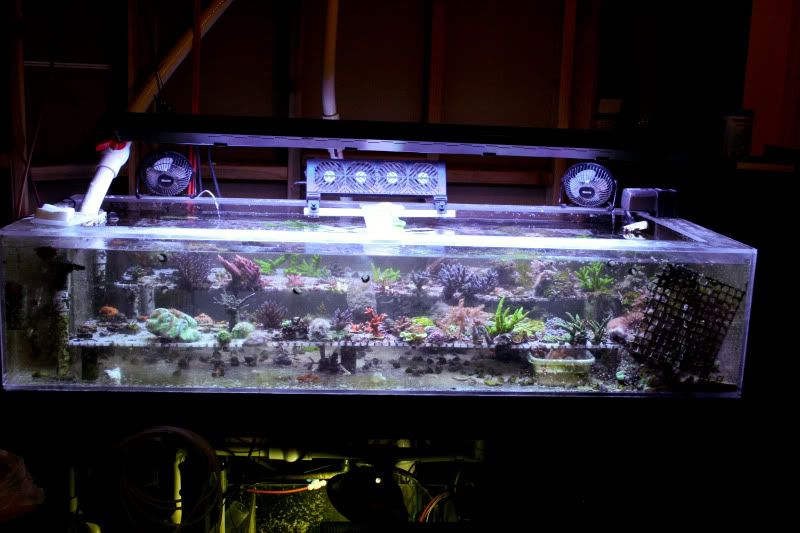
Frag - Before crash Aug 2010:
|
|
Original Crappy Reef Club Member #2
|
 |
Dion Richins
Presidency


Joined: April 03 2005
Location: Farmington
Status: Offline
Points: 11664
|
Post Options
Thanks(0)
Quote Reply
Posted: December 19 2011 at 10:14pm |
|
Did you add sand to the sand you already had? Or use all new sand?
|
|
|
|
chk4tix
Guest
Joined: April 06 2007
Location: Texas
Status: Offline
Points: 4320
|
Post Options
Thanks(0)
Quote Reply
Posted: December 19 2011 at 10:28pm |
 Dion Richins wrote: Dion Richins wrote:
Did you add sand to the sand you already had? Or use all new sand? |
I used all new sand except for a small amount of old sand from my previous tank to seed it.
|
|
Original Crappy Reef Club Member #2
|
|
Mark Peterson
Paid Member

Joined: June 19 2002
Location: Murray
Status: Offline
Points: 21436
|
Post Options
Thanks(0)
Quote Reply
Posted: December 20 2011 at 4:32pm |
Excellent write up and extremely useful before and after pics.  Thanks. Sorry, I always have so many questions.  My questions are numbered to help us keep track. That level of PO4 kills snails as you have discovered, but fish don't care much about PO4. 1. What fish have you lost and how did they go?
2. Are there any sand throwing Jawfish or Gobies currently in the display or any lost since setup? In a connected system, it's completely normal for each aquarium to have it's own personality. I don't see much nuisance algae in the display, assuming the Rabbitfish, Tangs and Angelfish are keeping it clean in the absence of snails. The manual algae removal you speak of is from the Frag tank, right? (That's question #4) 5. Is the Refugium growing algae? 6. What is the photoperiod of the Refugium light? 7. How do you feel about removing the highest eggcrate shelf from the frag system? Don't remove it yet, I just wanted you to be thinking about it. The difference in coral growth between the two tanks is expected. The frag tank is well designed, specifically to accelerate coral growth. The weird occurrence of two crashes shortly after setup make me wonder if there was something besides PO4 in the environment that may or may not have come in via the Utah sand. 8. Please describe exactly where the sand was collected. 9. Was it all collected from the surface or did you dig a hole to get sand from a little deeper? 10. Was the sand screened prior to washing? 11. Were there any trash objects found in the sand? 12. Is there any left over sand? If so I would like to see a macro pic of it and suggest we start with tests for strange odor and for PO4. 13. What PVC pipe was used and what cement was used to hold it together? 14. Are there any metal parts in the water purification and delivery system, even just a brass fitting or float valve? 15. Is the RO Membrane the same as before the 170? 16. Did you use any tap water to start up the 170? 17. Was there a change in the source water, like a change in the well that served your community? Each well provides water with slightly different impurities and sometimes an accidental or purposeful additive by the city that is no problem for humans can adversely affect coral and/or fish. Sometimes a city water line break allows dirt, and who knows what else, into the pipes. The effect of some contaminants can last for years. The dirt and contaminants from a repair are not spread out evenly across users, rather it follows the flow and the path of least resistance. As you can see, there are several possibilities. Much of what you have said does seem to point a finger at the sand, but if so, this is unlike any Utah Oolitic Sand I have ever seen. It's like digging in the dirt for clues. 
|
Reefkeeping Tips, & quick, easy setup tricks:www.utahreefs.com/forum/forum_posts.asp?TID=9244 Pay it forward - become a paid WMAS member
|
|
chk4tix
Guest
Joined: April 06 2007
Location: Texas
Status: Offline
Points: 4320
|
Post Options
Thanks(0)
Quote Reply
Posted: December 20 2011 at 7:37pm |
Thanks for the response Mark, very good list of questions. My responses are in red. I believe you might have given me a little hint on a possible cause....
1. What fish have you lost and how did they go?
Display tank (died within 2-7 days of crash, I assume ammonia or pH spike…not sure):
Mystery Wrasse
2 Bluespot Goby
Bluehead Wrasse
PowderBlue Tang
2 Firefish
YellowTailed Damsel
Aussie Black Clown
CopperBanded Butterfly
Pink Diamonda Goby
Sand Sifting Goby
2 Royal gama
Green Bullseye Manderian
Coral Beauty
Frag tank (died over time of starvation I believe):
2 yellow tangs
Kohl tang
Lawnmower blenny
2 yellow tailed damsels
2. Are there any sand throwing Jawfish or Gobies currently in the display or any lost since setup?
I lost 2 bluespots, a sand sifting goby in the crash, but I did replace the sand sifting goby and a pink and blue spot goby that both throw sand around.
In a connected system, it's completely normal for each aquarium to have it's own personality. I don't see much nuisance algae in the display, assuming the Rabbitfish, Tangs and Angelfish are keeping it clean in the absence of snails. The manual algae removal you speak of is from the Frag tank, right? (That's question #4)
Yes, the majority of manual algae removal is in the frag tank, however, I do have to manually remove algae from the overflows.
5. Is the Refugium growing algae?
Yes, I was growing cheto but the refug has also become overgrown with hair algae.
6. What is the photoperiod of the Refugium light?
It is currently on from 3am-11pm
7. How do you feel about removing the highest eggcrate shelf from the frag system? Don't remove it yet, I just wanted you to be thinking about it.
The only issue I have about removing the upper eggcrate is that the left side of it is encrusted by my SPS…but it’s not out of the question.
The difference in coral growth between the two tanks is expected. The frag tank is well designed, specifically to accelerate coral growth.
The weird occurrence of two crashes shortly after setup make me wonder if there was something besides PO4 in the environment that may or may not have come in via the Utah sand.
8. Please describe exactly where the sand was collected.
When we went out it was still wintertime and the roads/sand areas were covered in snow, however, I believe this is where we were. (we would have retrieved if from the south side of the roadway)
Map location
9. Was it all collected from the surface or did you dig a hole to get sand from a little deeper?
I dug about 12 down, which was below the frozen grown and then retrieved the sand from there.
10. Was the sand screened prior to washing?
It was not screened, but we did wash if for about 5-6 hours before it no longer was producing cloudy water and only kept the sugar sized sand.
11. Were there any trash objects found in the sand?
No trash, a few sticks here and there, but nothing larger than a dime in size.
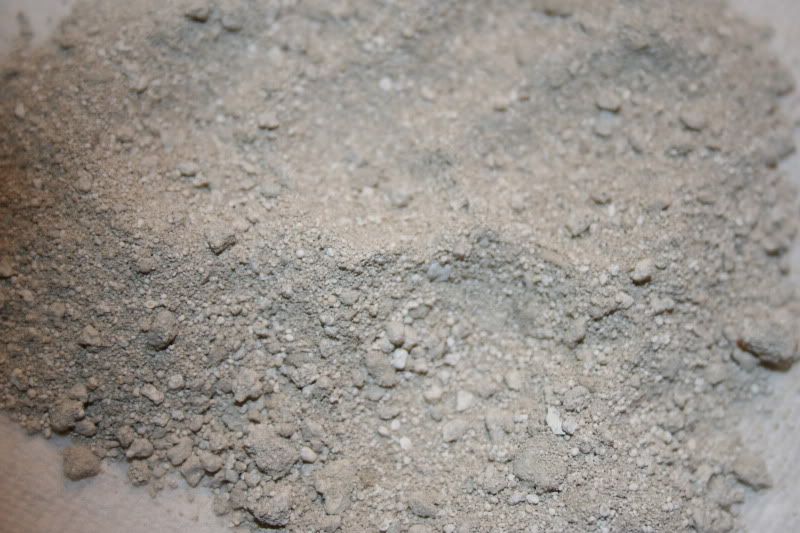
12. Is there any left over sand? If so I would like to see a macro pic of it and suggest we start with tests for strange odor and for PO4.
Yes, (I filled the kids sandbox with it as well.)
Smells like sand to me
Quick p04 test = 0.00 ( I will let the sand stay in the water for another day and then re-test)
Picture (straight out of sandbox, not cleaned):
13. What PVC pipe was used and what cement was used to hold it together?
Standard sch 200 1/2 PVC, pieces are not glued together
14. Are there any metal parts in the water purification and delivery system, even just a brass fitting or float valve?
No, I learned that lesson the hard way when I set up my first tank.
15. Is the RO Membrane the same as before the 150?
* Just to clarify, you do mean the actual RO membrane and not just the filters??? Strange you ask this, I didn’t even realized there was an RO membrane until my topoff stopped working two nights ago. I started to investigate and found that there was very little/no water flow through the large chamber, which apparently holds the RO membrane. Because of the topoff problem, I actually ordered on two nights ago. Either way, I have owned the RO/DI since late 2006, so that is something I will need to check into further.
16. Did you use any tap water to start up the 150?
No, used my RO to fill the tank.
17. Was there a change in the source water, like a change in the well that served your community? Each well provides water with slightly different impurities and sometimes an accidental or purposeful additive by the city that is no problem for humans can adversely affect coral and/or fish. Sometimes a city water line break allows dirt, and who knows what else, into the pipes. The effect of some contaminants can last for years. The dirt and contaminants from a repair are not spread out evenly across users, rather it follows the flow and the path of least resistance.
I called my city and asked, the person I talked to said there have not been any changes to the water supply for a very long time. so I will have to take their word on this
As you can see, there are several possibilities. Much of what you have said does seem to point a finger at the sand, but if so, this is unlike any Utah Oolitic Sand I have ever seen.
It's like digging in the dirt for clues
|
|
Original Crappy Reef Club Member #2
|
|
phys
Guest

Joined: March 04 2011
Location: Capitol Hill
Status: Offline
Points: 1982
|
Post Options
Thanks(0)
Quote Reply
Posted: December 21 2011 at 3:17am |
|
whats a new addition in equipment, rock, etc besides the sand?
|
|
chk4tix
Guest
Joined: April 06 2007
Location: Texas
Status: Offline
Points: 4320
|
Post Options
Thanks(0)
Quote Reply
Posted: December 21 2011 at 9:51am |
phys wrote:
whats a new addition in equipment, rock, etc besides the sand? |
the only other new equipement that wasn't on the 120g was the light. however, it was the same type, t5's.
|
|
Original Crappy Reef Club Member #2
|
|
Mark Peterson
Paid Member
Joined: June 19 2002
Location: Murray
Status: Offline
Points: 21436
|
Post Options
Thanks(0)
Quote Reply
Posted: December 21 2011 at 12:32pm |
Wonderful answers.  If you don't mind, I have a few more questions.
18. That's the general area but was the sand collected from a dune or mound or was it collected
from a low area, possibly lower elevation than the road? This next stuff may be boring but will indicate my extreme passion for and knowledge of the subject. Feel free to skip down to the points of concern. Many hobbyists have googled the sand and then followed the directions here: http://geology.utah.gov/utahgeo/rockmineral/collecting/oolitic.htm only to arrive at the place to find this: 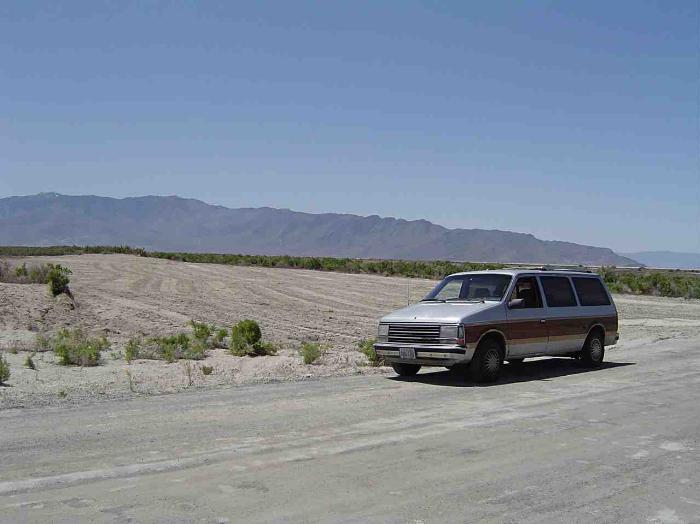 This pic looks SSW. This is the exact spot where the website given above directs us. Before the sand dunes were removed by Broken Arrow Salt and moved directly west to build their ponds in the summer of 2003, there was a sign marking the right spot. I had an interesting experience when I arrived in the van that day. I had been there only a month prior so when I arrived to find it all gone, I had an eerie feeling. It was as though I were in a Star Trek Next Generation episode where an entire city had mysteriously vanished off the face of a planet, having been taken by a life form called the Crystalline Entity. Anyway, the ground left after the scraping away of the dunes is too fine, or in other words contains non-Oolitic sand and too much fine particle mud. This would explain why rinsing took so long and why the sand you used may be an extra good source of PO4. This is a pic of uncleaned Oolitic from the dunes that still continue north of that road: 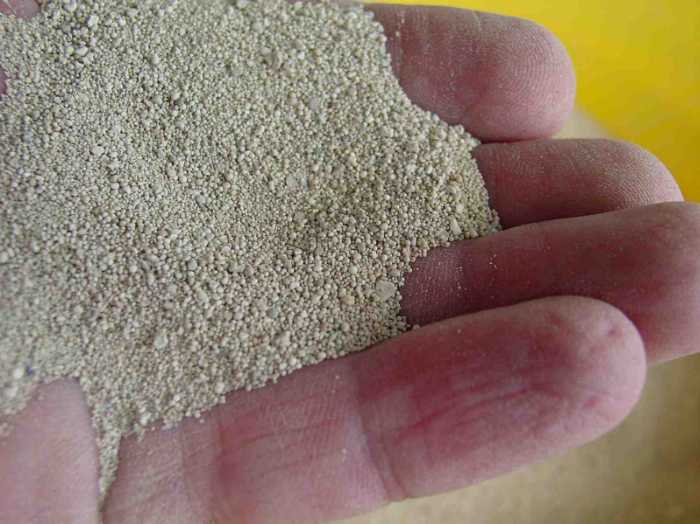 Notice the peculiar round and oblong shape. I don't see that shape as distinctly in the pic of sand from your sandbox. It indeed appears to have more mud, but it may just be the pic. My concerns:Among my concerns about your collecting sand from near the road in the winter, (under snow?) is that it would be difficult for someone unfamiliar with the sand to not only collect the wrong stuff, but to accidentally collect from an area where a petroleum product was spilled. Even years later the chemical residue remains and affects living organisms. Heavy equipment needs to be fueled and breaks down, leaving fuel and hydraulic fluid contaminated ground. This would definitely explain the series of crashes, the persistent nuisance algae and would be the reason that the 170 just never has reached the level of health, growth and beauty of the 120. My next concern is the water purification equipment purchased in 2006. I'm concerned that in the worst case scenario, water with impurities worse than tapwater has been used for several years for top-off and water changes. I'll explain this later after receiving your answers to these questions: 19. What is the TDS of the water from the unit? 20. When was the last time the DI resin/cartridge was replaced? 21. When was the last time the Membrane was replaced? 22. When were the prefilters replaced? The membrane is typically inside a smaller diameter cartridge mounted horizontally above the more easily unscrewed vertical cartridges housing the sediment prefilter, the Activated Carbon(AC) pre-filter and the DI resin/cartridge. A typical fourth vertical cartridge holds more AC as a post filter. Thank you for being so attentive my questions and to the detail of your answers. I believe we are getting close to discovering the root cause of this problem.
Edited by Mark Peterson - December 21 2011 at 12:40pm
|
Reefkeeping Tips, & quick, easy setup tricks:www.utahreefs.com/forum/forum_posts.asp?TID=9244 Pay it forward - become a paid WMAS member
|
|
chk4tix
Guest
Joined: April 06 2007
Location: Texas
Status: Offline
Points: 4320
|
Post Options
Thanks(0)
Quote Reply
Posted: December 21 2011 at 2:10pm |
|
Continuing on...Thanks again for all of your help
18. That's the general area but was the sand collected from a dune or mound or was it collected from a low area, possibly lower elevation than the road?
My concerns:Among my concerns about your collecting sand from near the road in the winter, (under snow?) is that it would be difficult for someone unfamiliar with the sand to not only collect the wrong stuff, but to accidentally collect from an area where a petroleum product was spilled. Even years later the chemical residue remains and affects living organisms. Heavy equipment needs to be fueled and breaks down, leaving fuel and hydraulic fluid contaminated ground. This would definitely explain the series of crashes, the persistent nuisance algae and would be the reason that the 170 just never has reached the level of health, growth and beauty of the 120.
All Valid points. The area I collected the sand from was from a low lying area. probably 50 yards from the roadway. Again, it was winter time and probably not the best time to try to collect sand in the first place, but I really wanted to get my tank up and going. I have always wondered if I collected the wrong sand, however, when it is washed and cleaned, it does look a lot like the sand shown in the pictures. (When I get home, I will take a few tank sand shots and add them to this section.)
My next concern is the water purification equipment purchased in 2006. I'm concerned that in the worst case scenario, water with impurities worse than tapwater has been used for several years for top-off and water changes. I'll explain this later after receiving your answers to these questions:
19. What is the TDS of the water from the unit?
The last time I checked (about two weeks ago) TDS was at 25ppm (my tapwater is at 445ppm.
20. When was the last time the DI resin/cartridge was replaced?
The DI resin was changed in late Oct.
21. When was the last time the Membrane was replaced?
It has never been changed. I ordered a replacement that arrived today, so I will be replacing this when I get home.
22. When were the prefilters replaced?
All other filters for the RO/DI were replaced in late Oct this year ( I get reminders from airwaterice.com to make sure I change them on time)
The membrane is typically inside a smaller diameter cartridge mounted horizontally above the more easily unscrewed vertical cartridges housing the sediment prefilter, the Activated Carbon(AC) pre-filter and the DI resin/cartridge. A typical fourth vertical cartridge holds more AC as a post filter.Thank you for being so attentive my questions and to the detail of your answers. I believe we are getting close to discovering the root cause of this problem.
|
|
Original Crappy Reef Club Member #2
|
|
Mark Peterson
Paid Member
Joined: June 19 2002
Location: Murray
Status: Offline
Points: 21436
|
Post Options
Thanks(0)
Quote Reply
Posted: December 21 2011 at 6:34pm |
Well, from what we've discussed here, from what I see in the pics and what you have worked on in the last year, we have eliminated everything else. I'm with you. I believe replacing the sand is going to resolve the issue. I had a problem last year with almost 10 gals of crushed coral I had traded for. Growth was almost zero for 4 months until I finally replaced it with good sand. Some kind of chemical treatment must have been used in the tank it came from, because running Poly Filter helped a lot. I burned through 5 Poly Filter pads @$6 each before admitting it was a PITA and finally replaced the sand. I moved all LR over to one side and replaced half the sand. A month later, with the LR all on the other side I replaced the other half of the sand. Good luck. - On the Refugium Light cycle, did you mean to say that it is ON at night? like from 9PM to 9AM. That's how I would do it. - After the sand is replaced I bet snails will stop dieing and you will be able to eliminate the algae. - The top shelf in the frag tank is acting like a really good Algal Turf Scrubber. After replacing the sand, I'd remove the shelf and do a thorough cleaning of the Refugium, re-starting it with new algae. 
Edited by Mark Peterson - December 21 2011 at 6:46pm
|
Reefkeeping Tips, & quick, easy setup tricks:www.utahreefs.com/forum/forum_posts.asp?TID=9244 Pay it forward - become a paid WMAS member
|
|
chk4tix
Guest
Joined: April 06 2007
Location: Texas
Status: Offline
Points: 4320
|
Post Options
Thanks(0)
Quote Reply
Posted: December 21 2011 at 7:28pm |
|
Thanks for the advice Mark, i will have to figure out how I am going to get the sand out but in the mean time, this is my plan of attack.
1. Replace RO membrane
2. do a couple of partial water changes
3. Continue carbon dosing and water testing
If I don't see the p04 making a dramatic change I will start pulling out the old sand and I guess at that point I will make the decision if I will put any sand back in or keep it barebottom instead
|
|
Original Crappy Reef Club Member #2
|
|
Mark Peterson
Paid Member
Joined: June 19 2002
Location: Murray
Status: Offline
Points: 21436
|
Post Options
Thanks(0)
Quote Reply
Posted: December 22 2011 at 8:00am |
|
Please keep us apprised. I would be fascinated to see whether carbon dosing can significantly reduce PO4in this tank.
|
Reefkeeping Tips, & quick, easy setup tricks:www.utahreefs.com/forum/forum_posts.asp?TID=9244 Pay it forward - become a paid WMAS member
|
|
Ryan Thompson
Guest

Joined: April 11 2006
Location: Lehi
Status: Offline
Points: 3546
|
Post Options
Thanks(0)
Quote Reply
Posted: December 22 2011 at 8:29am |
Mark Peterson wrote:
Please keep us apprised. I would be fascinated to see whether carbon dosing can significantly reduce PO4in this tank.
|
I would say carbon dosing is the only thing helping right now. 
If the sand is contaminated, which I believe is the root cause, it is leaching a bunch of P04 into the tank. The carbon dosing is doing what it can but contamination may be too high for the reef to handle.
Also, I think 25ppm on the RO is too high. Ideally, we want to 0 TDS but I don't think 10 TDS is a big problem. 25ppm is adding more nutrients to the tank and possibly compounding the problem.
Keith, I would pull the sand over a month or so and try bare bottom for a little bit. My next tank will be bare bottom so I can crank up the flow and just suck the detritus out with my weekly water change. I fight sand with every tank. Right now the hair algae for me is gone on the rocks but now stuff is appearing on the sand. My stupid snails and crabs barely touch the sand.
How do I fix it? Remove the sand!
Edited by Ryan Thompson - December 22 2011 at 8:31am
|
|
chk4tix
Guest
Joined: April 06 2007
Location: Texas
Status: Offline
Points: 4320
|
Post Options
Thanks(0)
Quote Reply
Posted: December 22 2011 at 9:26am |
|
I do plan on pulling the sand, my only concern about leaving it BB are the wrasses and the gobies. There are a few gobies I wouldn't mind catching and selling but I do like my wrasses, so I will need to figure that part out.
|
|
Original Crappy Reef Club Member #2
|
|
chk4tix
Guest
Joined: April 06 2007
Location: Texas
Status: Offline
Points: 4320
|
Post Options
Thanks(0)
Quote Reply
Posted: December 23 2011 at 5:48pm |
|
Well I started the removal of the old sand and I have come to the realization of how large of a task this is going to be. Within the first ten minutes I had already broken a few corals and accidentally broke my large coral off of the back wall where it had encrusted over the years. I don't know what is more frustrating a tank with water quality problems or destroying everything in the process of trying to make it "better".
|
|
Original Crappy Reef Club Member #2
|
|
chk4tix
Guest
Joined: April 06 2007
Location: Texas
Status: Offline
Points: 4320
|
Post Options
Thanks(0)
Quote Reply
Posted: December 31 2011 at 12:22pm |
|
Quick update: I removed all sand from my sump and about half of the sand from my display. I tested my p04's in all of my tanks. My display is at .76, my frag tank is .66, and my anemone tank is .63 which is further indication of contaminated sand. My fish don't seem to happy with the sand removal process but hopefully this will resolve my tank problems so I can get back to enjoying the tank again.
|
|
Original Crappy Reef Club Member #2
|
|
chk4tix
Guest
Joined: April 06 2007
Location: Texas
Status: Offline
Points: 4320
|
Post Options
Thanks(0)
Quote Reply
Posted: January 13 2012 at 10:57pm |
I decided to do a little up date on my status. Well in the last few weeks I have slowly removed the sandbed and decided to do a few experiments. I found (as Ryan suggested) that my dosing was the only thing keeping my tank p04 levels in the .70's. I stopped dosing for a period of 2 days and my p04s jumped back up to .89. Once I restarted dosing my p04s slowly came down to around .70. However, at this time I am still unable to get them lower than that. I moved a great deal of my LR down to my sump and move the corals that are still alive to my frag tank to help in the sand removal process. As of today I have removed approx 99% of the sand and do not think I could get out the dusting left unless I drain my tank which I do not plan on doing. I am running carbon and a filter to help water clarity from all my moving of rock and sand. I just did a p04 test and the level sits at .85 so now the real test begins to find out if it was my sand or if my tank is destined for the "for sale" threads. Here is a pic of my tank after all the sand was removed. It's a far cry from what it once was 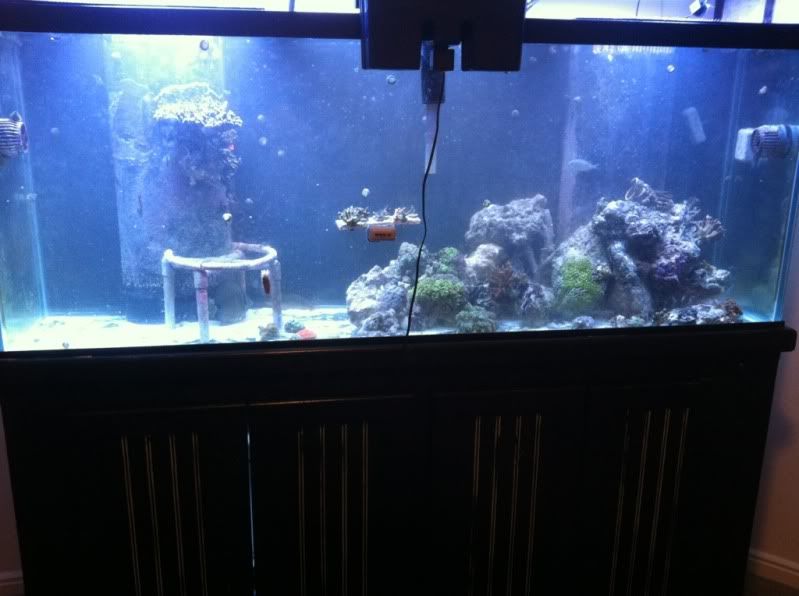
Edited by chk4tix - January 14 2012 at 8:14am
|
|
Original Crappy Reef Club Member #2
|
|
BobC63
Admin Group
Joined: January 17 2007
Location: Lehi, UT
Status: Offline
Points: 8973
|
Post Options
Thanks(0)
Quote Reply
Posted: January 14 2012 at 8:01am |
Do you still have the eggcrate in the frag tank?
I have heard that some brands of eggcrate leach PO4.
If you have removed all the sand and you still have that high PO4, then I'm afraid it wasn't the sand.
|
|
- My Current Tank: 65g Starfire (sitting empty for 2+ years) -
* Marine & Reef tanks since 1977 *
|
|
chk4tix
Guest
Joined: April 06 2007
Location: Texas
Status: Offline
Points: 4320
|
Post Options
Thanks(0)
Quote Reply
Posted: January 14 2012 at 8:20am |
BobC63 wrote:
Do you still have the eggcrate in the frag tank?
I have heard that some brands of eggcrate leach PO4.
If you have removed all the sand and you still have that high PO4, then I'm afraid it wasn't the sand.
ÂÂ
 |
I do still have the eggcrate in the frag tank, but if that was the cause, I would tend to think that the levels of P04 would be higher in the frag tank then anywhere else. One of the tests I preformed was to systimatically isolate tanks from the overall system, each time i did, there was a consistant increase in the p04 levels in the display but not in the frag or the anemonie tanks. So, I do not beleive the eggcrate is the source. I did expect the higher p04 levels after the sand removal because it stirred up all the dust and debre but if it doesnt drop, then I aggree it wasnt the sand. If it isnt the sand, then my money pit will need to find a new home. *as of this morning p04 is .62
Edited by chk4tix - January 14 2012 at 9:38am
|
|
Original Crappy Reef Club Member #2
|
|
BobC63
Admin Group
Joined: January 17 2007
Location: Lehi, UT
Status: Offline
Points: 8973
|
Post Options
Thanks(0)
Quote Reply
Posted: January 14 2012 at 9:48am |
Are you using any type of phosphate removal media like Phosban or RowaPhos?
If you have removed the source of the pO4 (by removing the sandbed) then adding a reactor with pO4 remover should reduce the pO4 level to very close to zero rather quickly, provided you use enough quantity.
If you add the pO4 remover to your regimen and the pO4 does not go down substantially, then my next place to look is in your source water.
Have you ever tested your tap water for pO4?
|
|
- My Current Tank: 65g Starfire (sitting empty for 2+ years) -
* Marine & Reef tanks since 1977 *
|
|