| Author |
 Topic Search Topic Search  Topic Options Topic Options
|
Adam Blundell 
Presidency


Joined: June 24 2002
Location: Davis County
Status: Offline
Points: 18526
|
 Post Options Post Options
 Thanks(0) Thanks(0)
 Quote Quote  Reply Reply
 Topic: Actinic Lights Topic: Actinic Lights
Posted: February 26 2004 at 9:10pm |
I have an actinic/blue light question for everyone. I saw a very beautiful tank the other day, and I was surprised by something. This tank has its blue lights on for about 4 hours per day. Two hours in the morning, and two hours in the evening, while the white lights are on. But during the day, only the white lights are on, and not the blue lights. These are all compact flourescent, by the way.
Does anyone else run white lights only during the day, and run their blues only in the morning and evening?
Adam
|
|
Come to a meeting, they’re fun!
|
 |
timlaw
Guest


Joined: November 04 2003
Status: Offline
Points: 24
|
Post Options
Thanks(0)
Quote Reply
Posted: February 26 2004 at 11:19pm |
I have 2-400 watt metal halides which really brightens up my 150 gallon but it is the actinic that I run before, during, and after the halides come on that seem to bring out the color in my corals and fish. I say if you have them then leave them on.
Tim
|
|
ewaldsreef
Guest

Joined: December 07 2002
Location: United States
Status: Offline
Points: 3752
|
Post Options
Thanks(0)
Quote Reply
Posted: February 27 2004 at 6:08am |
|
Adam, You said that the tank was beautiful. Do you know how long it was set up using this light schedule? And also what king of corals? I would think it would be more benificial to run the actinincs all day. Would this person be willing to try that for a month and see if it made a differance?
|
|
Contact me for professional aquarium maintenance and localy grown coral frags. [URL=http://www.aquatitranquility.com][/URL]
|
|
jfinch
Guest

Joined: March 06 2003
Location: Pleasant Grove
Status: Offline
Points: 7067
|
Post Options
Thanks(0)
Quote Reply
Posted: February 27 2004 at 6:51am |
|
I always thought actinics were for visual asthetics more then coral health. If you like the look of your tank without actinics then save your money and don't use them at all. Personally, I think all tanks, or MH bulbs, look better with actinics (and I mean 420nm light, not blue bulbs).
|
|
|
|
Adam Blundell
Presidency
Joined: June 24 2002
Location: Davis County
Status: Offline
Points: 18526
|
Post Options
Thanks(0)
Quote Reply
Posted: February 27 2004 at 7:08am |
The tank has been set up for around 7 months. It has xenia and mushrooms, but also star polyps and a couple small acro frags. The tank looks great, so I'm not suggesting they change anything. And the owner likes the look of the tank without the blue lighting.
I was just surprised, because to my knowledge this is the only tank in our club that doesn't run blue lighting during the day.
Adam
|
|
Come to a meeting, they’re fun!
|
|
Travis
Guest

Joined: September 23 2003
Location: United States
Status: Offline
Points: 621
|
Post Options
Thanks(0)
Quote Reply
Posted: March 05 2004 at 5:11pm |
Interesting. I also was under the impression actinic were for looks more than anything. What spectrum are the white lights? Personally I don't like my 10k MH w/o actinics... to yellow for me. On the 55g I have 10k PC and they are not nearly as yellow looking but I still like the looks of actinic's on that one also.
|
|
Weimers
Guest

Joined: January 01 2004
Location: United States
Status: Offline
Points: 2080
|
Post Options
Thanks(0)
Quote Reply
Posted: March 05 2004 at 7:32pm |
We haven't been running our blue lights during the day. Only when someone like Mark or Marcus come over. Ha ha! Just trying to make it look niftier for the gurus. We run the blue lights for 1/2 hour first thing in the morning and 1/2 hour before we turn the lights off completely. Does it help the corals to leave the lights on during the day? We were told the blue lights didn't "do anything" for any of the inhabitants, other than let them know it's almost time for "sunrise" and "sunset."
Renee
|
|
Adam Blundell
Presidency
Joined: June 24 2002
Location: Davis County
Status: Offline
Points: 18526
|
Post Options
Thanks(0)
Quote Reply
Posted: March 05 2004 at 8:04pm |
 Weimers wrote: Weimers wrote:
We were told the blue lights didn't "do anything" for any of the inhabitants, other than let them know it's almost time for "sunrise" and "sunset." |

Where did you hear that???
Adam
|
|
Come to a meeting, they’re fun!
|
|
Mark Peterson
Paid Member


Joined: June 19 2002
Location: Murray
Status: Offline
Points: 21437
|
Post Options
Thanks(0)
Quote Reply
Posted: March 05 2004 at 8:36pm |
Lighting 101
Lighting is just the opposite to what some of you have thought. Blue light is necessary for coral growth. It is my understanding that the algae within the coral tissue called zooxanthellae, respond best to the blue around 420 nanometers wavelength. Adding the rest of the wavelength/spectrum which makes it look white, is for showing off the full spectrum of color; for looks. 
The reason that slightly bluish colored (10K-20K)Metal Halide lighting is so successful is that it puts out a lot of light energy in a more complete range of wavelengths. The bright blue that is emitted benefits all the coral and the rest of the spectrum benefits surf zone coral as they are more suited to the full spectrum of light.
It's entirely probable that modern 10-20K MH puts off enough 420 nm light to eliminate the need for other blue lighting.
Not all blue fluorescent lights actually emit 420nm wavelenths. Some lights seem to be painted blue which is pitiful. It's when the "phosphors" inside the tube actually glow blue at the proper wavelength that they are most effective.
VHO and NO URI Super Actinic R and Blue Moon brand fluorescent lights are the best I've seen for this, even better than the original "Actinic 03" I don't know which brand of Power Compact Fluorescent is best, but the Helios brand seems okay to me.
Renee, what I meant a while back about your lights was to turn on the blue in the morning when you leave for work so that you can enjoy the tank, leave them on all day and then turn them off after the MH go off. The main point was to reduce the amount of time the MH were on (photoperiod), because you had them on from 5AM till 8PM (15 hours )and that was growing your algae like crazy. I believe I suggested the MH come on after 2PM and then off a little while before the blues go off before you head for bed. If this is not what you understood, I'm sorry for not explaining it better.
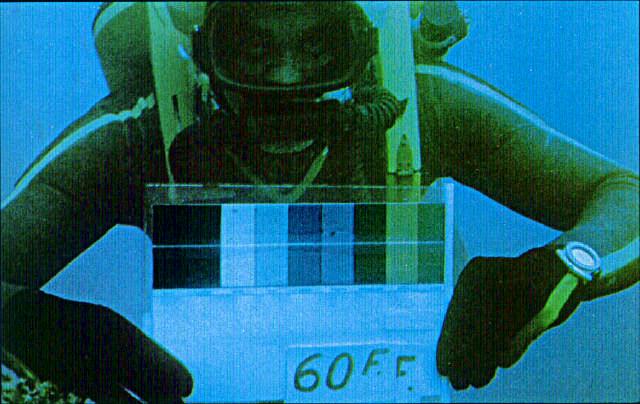
Blue light is the color that all coral receive ALL DAY LONG as these photos from surf level down to 60 feet illustrate.


Edited by Mark Peterson
|
Reefkeeping Tips, & quick, easy setup tricks:www.utahreefs.com/forum/forum_posts.asp?TID=9244 Pay it forward - become a paid WMAS member 
|
|
rstruhs
Guest

Joined: October 18 2003
Location: Japan
Status: Offline
Points: 1003
|
Post Options
Thanks(0)
Quote Reply
Posted: March 05 2004 at 8:50pm |
So that's why the ocean is blue!
Does anyone have access to a light meter or something that is capable of measuring the wavelength of the lights on our aquariums?
|
|
Rodney, Sandra, Jeffery, and Laura Struhs
South Jordan, Utah 98th South & 40th West.
(801) 282-2744
75 gallon reef
55 gallon reef
55 gallon FOWLR
20 gallon FOWLR
|
|
Adam Blundell
Presidency
Joined: June 24 2002
Location: Davis County
Status: Offline
Points: 18526
|
Post Options
Thanks(0)
Quote Reply
Posted: March 05 2004 at 8:51pm |
This is about the 4th time Mark has posted those pics, and everytime I start to cringe. I'm not sure those pics are educational, sometimes I think they are misleading. And I do think that simply painting a bulb blue will work just as well as an actual blue light emitting bulb. However, when you paint the bulb blue, what you need to realize is that you highly reduce the amount of light it is giving off. So you could use a regular home depot metal halide, like 450 watt, paint it blue, and will work just like a 30 watt blue metal halide. I remember asking Dana about this years ago. Knowing this, some people have used blue celophane wrap, like see through Christmas wrapping paper, and covered their windows in their houses near their aquariums. That way you can use superbright sunlight, but only use the "blue" portion that gets through the "filter". I think it is a great idea.
I should also mention that I do completely agree with Mark that blue light is way way way important.
Adam
|
|
Come to a meeting, they’re fun!
|
|
Adam Blundell
Presidency
Joined: June 24 2002
Location: Davis County
Status: Offline
Points: 18526
|
Post Options
Thanks(0)
Quote Reply
Posted: March 05 2004 at 8:52pm |
Rodney,
I have a photometer, but it doesn't tell you what you are receiving for different wavelengths. I've often thought of buying one, but never have. May be a better club purchase to have.
Adam
|
|
Come to a meeting, they’re fun!
|
|
Weimers
Guest
Joined: January 01 2004
Location: United States
Status: Offline
Points: 2080
|
Post Options
Thanks(0)
Quote Reply
Posted: March 05 2004 at 10:20pm |
Mark,
We heard the "sunrise/sunset" thing from someone before you came over. We have been following your advise since and have pretty much beat the algae problem. Thanks. I really can't remember where we heard to use the blue lights as a sunrise/sunset. Wish I could. We also had been told that the blue lights are only for the viewers pleasure. I am glad to know that they are necessary for the health. Don't feel like we spent the money for nothing now.
|
|
Renee and Damon Weimer
Tankless in Hawaii
|
|
Travis
Guest
Joined: September 23 2003
Location: United States
Status: Offline
Points: 621
|
Post Options
Thanks(0)
Quote Reply
Posted: March 06 2004 at 12:08am |
Intensity vs spectrum quality... not a new debat but it's still being debated. The way I understand things is the PAR rating on the bulbs is the key. The 6500k Iwaski is supposed to produce one of the highest par ratings of all MH. It is rumored that the 6500k Iwaski produces a greater coral growth than other bulbs for that very reason. The 10,000k XM's are supposed to be just under the Iwaski's so now we have a "good growth" bulb in the 10,000k flavor. The 20,000k bulbs are said to produce the slowest growth rate due to the lower par ratings... it would seem to me if the bluer spectrum was really important to the corals that the 10,000k & 20,000k bulbs would produce more growth than the 6500k bulbs.
I understand the lighting corals get in the ocean is dominated by the blue spectrum but when it comes to photosynthesis (and that is what it all boils down to) all spectrums of light play a key role. IMO, Since our tanks are not 20' to 60' deep our corals benefit more from a full spectrum bulb than a actinic.
I agree painted bulbs... 7100k PC etc will cause a drop in lighting out put. I was happy to see the "true" actinic PC's come out.
I run my 110g lighting schedule like this... 12:00pm actinics on... 1:00pm MH on... 9:00pm MH off... 10:00pm actinics off.
Edited by Travis
|
|
Travis
Guest
Joined: September 23 2003
Location: United States
Status: Offline
Points: 621
|
Post Options
Thanks(0)
Quote Reply
Posted: March 06 2004 at 7:33am |
Here's and interesting article... read the entire article before making a conclusion... http://www.advancedaquarist.com/issues/feb2002/Feature.htm
|
|
jfinch
Guest
Joined: March 06 2003
Location: Pleasant Grove
Status: Offline
Points: 7067
|
Post Options
Thanks(0)
Quote Reply
Posted: March 06 2004 at 11:13am |
For the lazy, here's some quotes from that article by Dana Riddle:
(the lamps compared were a 4000K philips bulb ($20) and the Sunburst 12000K bulb ($75))
This experiment’s results suggest information potentially valuable for hobbyists - that rates of photosynthesis were essentially the same under these two distinctly different light sources. Other than aesthetic value, there appears to be no advantage, photosynthetically speaking, in using high Kelvin lamps.
The implication of these results should be of interest to hobbyists; it suggests that lamp selection (with due regard to lamp intensity) may be based on appeal, whether that is price or the "look" it gives to a tank, without fear of hindering photosynthesis. Economy-minded hobbyists and coral farmers may find this especially useful. It appears that light intensity and relatively simple light measurements alone adequately judge lamp efficiencies within the context of zooxanthellae photosynthesis. This should not be construed to mean that all light sources are adequate for reef aquaria use.
|
|
|
|
Mark Peterson
Paid Member
Joined: June 19 2002
Location: Murray
Status: Offline
Points: 21437
|
Post Options
Thanks(0)
Quote Reply
Posted: March 06 2004 at 11:55pm |
|
Isn't the real point here, what coral do I want to keep and what is the light spectrum and intensity in it's natural environment?
And yet, I've noticed that some coral do well in lighting that is not natural to them. Whether they adapt or were not that picky in the first place, I don't know.
Dana is a great person and his judgement and opinions add value to the hobby. We had him speak to the club in June 1997 (the VHS video of his presentation is in the WMAS Library) and at that time he donated a signed copy of his then new book, The Captive Reef, (which is also in the Library), This book has extrememly valuable information regarding corals being placed in the aquarium according to the many conditions they experience in their particular wild habitat, including the intensity and color/wavelength of light they receive. it also begins to discuss Dana's initial work regarding PAR (Photosynthetic Active Response).
As far as I can tell, the article simply tells us that the yellower MH grew a particular coral as well as the bluer MH. It's simply common sense that for coral, increased light intensity, to a point, stimulates growth.
After reading and thinking about Dana's conclusions, I suggest that in the absence of intense MH lighting, the lower intensity, fluorescent lighting schemes of NO, VHO and PC should have a major amount of blue light.
|
Reefkeeping Tips, & quick, easy setup tricks:www.utahreefs.com/forum/forum_posts.asp?TID=9244 Pay it forward - become a paid WMAS member
|
|
Jake Pehrson
Admin Group

Joined: June 13 2002
Location: Murray, UT
Status: Offline
Points: 4279
|
Post Options
Thanks(0)
Quote Reply
Posted: March 07 2004 at 12:13am |
I think that it has yet to be proven that "blue" or "actinic" light actually stimulates coral growth or increase coral health. I know people (like Marc Weiss) have stated that 420nm light increases coral growth, but I think this is mainly marketing.
In fact I have read many acticles that have shown that Acropora actually grows faster under 6,500K lights than under high kelvin lights.
And although I had not read the article by Dana Riddle I agree with what he said (thanks for the quote Jon). Other than aesthetic value, there appears to be no advantage, photosynthetically speaking, in using high Kelvin lamps.
|
|
|
|
chrisslc
Guest

Joined: November 13 2003
Location: United States
Status: Offline
Points: 799
|
Post Options
Thanks(0)
Quote Reply
Posted: March 07 2004 at 8:49am |
Does the fact that the blue light is absorbed less than other light create a benefit here? It seems here that coral does not care about wavelength but it does care about intensity. Doesn't the blue light reach the coral at a greater intensity than the same wattage light, the same distance, of a different color. Or, as a layman in light, am I misunderstanding the principles?
|
|
Murray, Utah just north of the park.
"It's all the same to the clam" -Shel Silverstein
|
|
Adam Blundell
Presidency
Joined: June 24 2002
Location: Davis County
Status: Offline
Points: 18526
|
Post Options
Thanks(0)
Quote Reply
Posted: March 07 2004 at 9:41am |
I strongly believe in blue light, because of it's importance to plants. Yes corals aren't plants I know. But I have recorded photosynthesis rates in corals before, and I am sure they are using blue light to excite electrons in the chain. I bet I have some nifty graphs at home, I'll look later.
However, get this, if you have enough bright white light, then I guess you wouldn't need blue light because you may already be running at full photosynthetic capacity. I just don't think many, if any, of us have that much light.
Aside from photosynthetic properties, and asthetic pleasure, I still think blue light can make a tank look more "real".
Adam
|
|
Come to a meeting, they’re fun!
|
|