| Author |
 Topic Search Topic Search  Topic Options Topic Options
|
Marcus 
Guest


Joined: August 28 2002
Location: United States
Status: Offline
Points: 1398
|
 Post Options Post Options
 Thanks(0) Thanks(0)
 Quote Quote  Reply Reply
 Posted: April 07 2004 at 10:16pm Posted: April 07 2004 at 10:16pm |
|
corey, thanks for the support. Not I didn't get a full refund and I returned all the materials so I didn't get to try to build another tank with it.
|
 |
meterman
Guest

Joined: January 30 2004
Location: United States
Status: Offline
Points: 216
|
Post Options
Thanks(0)
Quote Reply
Posted: April 08 2004 at 8:49am |
Marcus - Sad story! If I were in your shoes, there's no way I would accept a partial reimbursement. How many hours did you spend making the tank? Time is money my freind - even if it's spent on a hobby.
|
|
Alex
|
|
Marcus
Guest
Joined: August 28 2002
Location: United States
Status: Offline
Points: 1398
|
Post Options
Thanks(0)
Quote Reply
Posted: April 08 2004 at 9:48am |
|
Total - probably 12 hours continuosly. I wish I had got more money but this is a live and learn situation. Thanks for your support!
|
|
tomason
Guest
Joined: April 08 2003
Location: United States
Status: Offline
Points: 137
|
Post Options
Thanks(0)
Quote Reply
Posted: April 16 2004 at 5:21pm |
|
I noticed as I read through this thread that the conflict was based more on a misunderstanding than a mistake, so now that it's aged for a week, I thought I might explain why. My intent is to help a little so that we all understand buying acrylic sheet a little better. That way, no one has a problem like this in the future.
Marcus mentioned in another thread that Regional Supply told him that the cell cast sheet comes bigger than 48". That's right, it does! They all do. The reason is to allow for saw cuts. For example, out of a standard-sized 4' sheet, you can get 2 pieces that are a full 24" long. If the piece were really just 48", then you'd end up with a 24" piece and a 23 7/8" piece because the saw blade is about 1/8" typically. A 2x4 is 1.5"x3.5". You just have to know that or measure it.
A 4' piece was ordered, so they cut off the end of a 4'x8' sheet. That's just how it works. The vast majority of their customers know that, expect it, and plan for it. Given the reason for the extra they give you, many of Regional's customers probably actually need that extra bit. For that reason, that they offered to cut the pieces down to 48" for free really was a nice thing for them to do.
When I was shopping around for acrylic sheet last year, I came across one distributor that did warn about the extra bit they give you and that all their cut-to-size pieces are rough cut. They charged an extra $5 per cut for an accurate cut.
Since Marcus was able to make the extra size work, the fatal problem ended up being the failure of the Weld-On 40 seam. The salesman at Regional was honest and said he didn't know anything about #40. He suggested following the instructions on the package, which is reasonable. Marcus did, it didn't work, and IPS admitted to the fact that their instructions were wrong. For that reason, it seems like the blame for the ultimate failure of the seams should be placed on IPS. I think they should have been the ones to reimburse him for everything.
So essentially, because the cuts were "correct" for what's standard in that industry, and no incorrect information was given by Regional Supply, it really says a lot about them that they gave him most of his money back. From their perspective, it was really bending over backwards.
If you go to the Reef Central DIY forum, there's a huge thread about acrylic fabrication. Every question you could possibly have is answered there. There are at least 2 professional acrylic workers over there who help people (AcrylicMan and Acrylics). They both agree that Weld-On 40 is NOT the right cement for hobbyists. They recommend #4 possibly mixed with up to 20% #5 to slow down the set time and give you more time to adjust the pieces to make sure everything is square and flush. Weld-On 40 requires a bevel cut and has more stringent environmental requirements, among other things. Even though solvent welding requires a smoother edge, it's much easier for a hobbyist with garage tools to create a reliable seam. The "pins method" which BananaTropics used on his acrylic tank, and which is described in great detail on Reef Central, works very well! If you take the time to make the proper jigs, it's also extremely easy.
-Tom
|
|
tom-
Guest

Joined: November 28 2003
Location: United States
Status: Offline
Points: 418
|
Post Options
Thanks(0)
Quote Reply
Posted: April 16 2004 at 8:39pm |
|
actually Regional Supply said that it should have ben cut on a 10 deg of of 90. and they didn't do it because they did not have the ability. but they also didn't tell him that it needed to be doneor he would of had it cut somewhere else. so it was bound to fail even if the glue held.
|
|
Adam Haycock
Guest

Joined: August 23 2003
Location: Fiji
Status: Offline
Points: 2647
|
Post Options
Thanks(0)
Quote Reply
Posted: April 16 2004 at 9:19pm |
Yes, the "pins method" worked very well for me. If anyone is interested in doing a DIY acrylic project, I still have solvent (Weld-on #4 and #16), jigs, and applicator bottles if anyone needs to use them.
|
|
|
|
Ryan Willden
Guest

Joined: July 12 2002
Location: Canada
Status: Offline
Points: 775
|
Post Options
Thanks(0)
Quote Reply
Posted: April 16 2004 at 9:42pm |
Tom, 
I agree 100%
Edited by Ryan Willden
|
|
Marcus
Guest
Joined: August 28 2002
Location: United States
Status: Offline
Points: 1398
|
Post Options
Thanks(0)
Quote Reply
Posted: April 16 2004 at 11:27pm |
tomason, I took Regional a diagram of the sizes that needed to be cut. The offer from 49-3/4" down to 48" should not have been a coutesy. The diagram should have been followed corectly. But I agreed to keep the pieces so its my fault. The other thing about the "honesty" of the salesperson at Regional is that when I took the material back, the manager told me that "of course they need to be cut at a 10 deg. angle". Well, I should not have to ask who the expert is. The manager also told me that they were unable to cut it at a 10 deg angle. Their manufacturing show can do it but its a separate company and that's how they stay in business and its a trade secret. I don't care anymore about this tank, its done and I want to move on and buy a glass tank.
|
|
ollie
Guest

Joined: April 13 2004
Location: United States
Status: Offline
Points: 36
|
Post Options
Thanks(0)
Quote Reply
Posted: April 17 2004 at 7:56am |
|
You asked if there is a better way to polish the edges. There is. First, you router the edge as planned. Then you get a hydrogen torch (never tried an oxy/acetalene, might work but probably too dirty) and melt the freshly routered edge. It shines/melts up instantly. This is how the commercial acrylic places do it. You have to be very careful. The torch is very hot and you quickly and briefly touch the flame to the routered edge only. It works very well. I've built a few tankd and all turned out well, at least on the polished/burnished edges. If your interested, I'll tell you more about how I did it.
|
|
Drizzy
Guest

Joined: March 29 2004
Status: Offline
Points: 15
|
Post Options
Thanks(0)
Quote Reply
Posted: May 08 2004 at 8:52am |
 BananaTropics wrote: BananaTropics wrote:
Yes, the "pins method" worked very well for
me. If anyone is interested in doing a DIY acrylic project, I still
have solvent (Weld-on #4 and #16), jigs, and applicator bottles if
anyone needs to use them.
|
what are the "jigs" you refer to? I have all the rest...
|
|
tomason
Guest
Joined: April 08 2003
Location: United States
Status: Offline
Points: 137
|
Post Options
Thanks(0)
Quote Reply
Posted: May 08 2004 at 1:46pm |
|
The jigs keep the pieces that are going to be glued together square while you glue the joint, pull the pins, and then while the seam cures. That way, the seams don't end up with gaps and the tank is square when you're done.
-Tom
|
|
Adam Haycock
Guest
Joined: August 23 2003
Location: Fiji
Status: Offline
Points: 2647
|
Post Options
Thanks(0)
Quote Reply
Posted: May 08 2004 at 2:21pm |
Drizzy, here's a picture.
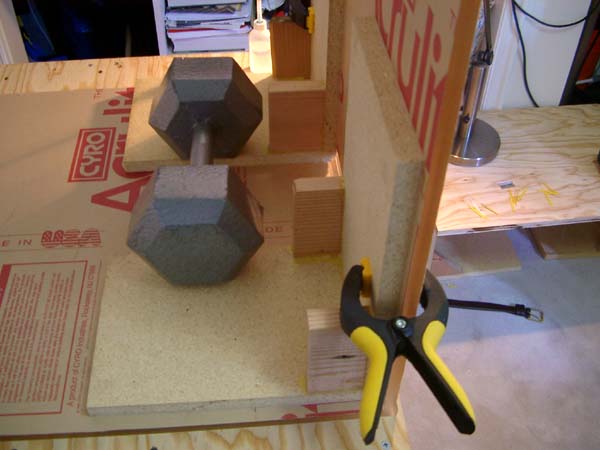
They have a small notch removed where the two pieces of acrylic come together to prevent solvent from being sucked under the jigs. The clips I used (in picture) only cost about $1 at HD. Still have them if you would like to use them.
|
|
|
|
tom-
Guest
Joined: November 28 2003
Location: United States
Status: Offline
Points: 418
|
Post Options
Thanks(0)
Quote Reply
Posted: May 09 2004 at 12:16am |
|
you can not flame the edges of the stuff Marcus had. It was cast. But flaming works great on most acr.
|
|