Quick ID question
Printed From: Utah Reefs
Category: Specialized Discussion
Forum Name: Invertebrates
Forum Description: This is the place to ask questions about invertebrates.
URL: http://www.utahreefs.com/forum/forum_posts.asp?TID=1679
Printed Date: July 05 2026 at 5:14am
Software Version: Web Wiz Forums 12.03 - http://www.webwizforums.com
Topic: Quick ID question
Posted By: ssilcox
Subject: Quick ID question
Date Posted: January 13 2004 at 5:07pm
|
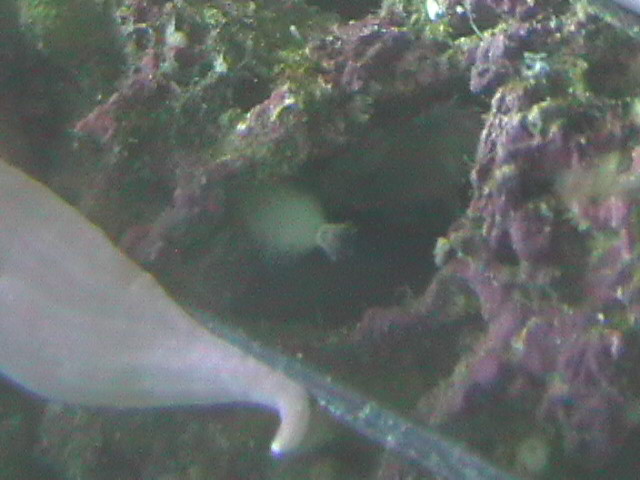
I have three of these (that I can see) that popped up in my tank over the last couple weeks... they look like spider egg sacks - kinda cottony - with what looks like a feather duster popping out the top. But they dont act like feather dusters, they never retract. Anywho a picture speaks a thousand words:
|
Replies:
Posted By: ffc3
Date Posted: January 13 2004 at 5:27pm
| I've got dozens of these on my overflow and refugium and am curious what they are also. |
Posted By: Marcus
Date Posted: January 13 2004 at 6:14pm
| They are good to have. Some sort of bi-valve, like a squirt. |
Posted By: ssilcox
Date Posted: January 13 2004 at 6:40pm
|
Cool. Thanks for the ID Marcus! |
Posted By: ewaldsreef
Date Posted: January 13 2004 at 6:46pm
|
They aren't like a sponge are they Marcus? ------------- Contact me for professional aquarium maintenance and localy grown coral frags. [URL=http://www.aquatitranquility.com][/URL] |
Posted By: Marcus
Date Posted: January 13 2004 at 6:48pm
| I guess, sort of. Sponges filter the water and squirts do to. |
Posted By: Adam Haycock
Date Posted: January 13 2004 at 7:12pm
|
Ive heard them refered to as "q-tip sponges" or "pineapple sponges" before. ------------- 
|
Posted By: Adam Blundell
Date Posted: January 13 2004 at 9:54pm
|
They are sea squirts. I type of tunicate and in some tanks they are out of control (not a bad thing). You know how some tanks have tons of aptasia, or some have tons of coraline algae or tons of xenia. Well some people have these flourish in their tanks. I think they are pretty cool, my old tank had quite a few of them. Adam ------------- Come to a meeting, they�re fun! |
Posted By: Mark Peterson
Date Posted: January 13 2004 at 11:37pm
|
I love those little guys filtering the water. But why do they call them squirts!
This reminds me of a pic of green Sponge I found somewhere on the web. pretty cool. 
I was at a members house today, admiring his black Sponge growing on the bottom of a live Brain Coral and then saw that it had sprung up in the overflow along with pink and white sponge. Way cool. ------------- Reefkeeping Tips, & quick, easy setup tricks: www.utahreefs.com/forum/forum_posts.asp?TID=9244 Pay it forward - become a paid WMAS member 
|
Posted By: SSpargur
Date Posted: January 14 2004 at 12:28am
|
I have thousands of these in my sump and in my overflow. Never really worried about them as they aren't bothering anything. Nice to know what they are though.
------------- Sean Spargur West Valley, UT |

Posted By: Adam Haycock
Date Posted: January 14 2004 at 10:52am
|
Adam, do you have the scientific name? -------------
|
Posted By: Jake Pehrson
Date Posted: January 14 2004 at 11:52am
|
Banana Tropics, I know this question was for Adam, but I will answer it also. Adam's will follow I am sure. Tunicates fall under the Phylum Chordata, Subphylum Urochordata. Most Sea Squirts usually fall under the Class Ascidiacea. With over 1,000 species of sea squirt it is almost impossible to identify them to Genus or Species (at least for me). ------------- Jake Pehrson Murray http://coralplanet.com" rel="nofollow - coralplanet.com http://utahbeeranch.com" rel="nofollow - :) |
Posted By: Adam Blundell
Date Posted: January 14 2004 at 1:26pm
|
Sorry Jake but I won't answer, because you probably know more about them than I do. Adam ------------- Come to a meeting, they�re fun! |
Posted By: Sarnack
Date Posted: January 14 2004 at 4:58pm
|
Jake - get that info from here?:
http://www.biologicall.info/PARTICULAR_BIOLOGY/Superkingdom_Eukaryotae/Kingdom_Animalia/Phylum_Chordata/Subphylum_Tunicates.html - http://www.biologicall.info/PARTICULAR_BIOLOGY/Superkingdom_ Eukaryotae/Kingdom_Animalia/Phylum_Chordata/Subphylum_Tunica tes.html Pretty interesting, I wondered how something that looked like a sponge could be in the Chordata Phylum. |
Posted By: FuzzyWeasel
Date Posted: February 11 2004 at 10:14am
|
I've got thousands of these things in my tank. These and my carribean red fan worms are growing over everything. Well... the squirts are on the bottoms of everything out of direct light. If anyone would like a chunk of rock with a couple on it I am doing some experiments with aritifical live rock and have small rocks with this stuff on it. I'd be happy to send it your way.
- Fuzzy Weasel
|
Posted By: Mark Peterson
Date Posted: February 11 2004 at 10:28am
How can rock be artificial and live at the same time? I'm curious. Please describe.  ------------- Reefkeeping Tips, & quick, easy setup tricks: www.utahreefs.com/forum/forum_posts.asp?TID=9244 Pay it forward - become a paid WMAS member
|
Posted By: FuzzyWeasel
Date Posted: February 11 2004 at 10:45am
|
What makes a rock "live" at all? It is the bacteria, hitch-hickers, and algae on it. I'm producing rock using environmentally friendly materials that doesn't affect the chemistry of the tank and grows all of the same goodies that live rock does. I do know that it grows corraline as well or better.... and I can shape these rocks into whatever I want. My centerpeice rock is a cave rock about the size of a football with a couple of "shelves" hanging off of it. It now has corraline covering most of it and has a patch of yellow star polyps that are spreading over to it. I don't have a working digital camera right now but will be getting one soon... I look forward to posting pics on it. As far as my research... I am trying to find ways to make the rock more porous and trying to get it the same hardness as natural live rock. The one thing I'll never have is the breath-taking diversity of live that hitch-hikes in on live rock. But for now I am just wanting to do research on an environmentally safe way to do reef tanks so that I don't contribute to the distruction of some of the most beautiful places on earth. I'm not an environmental nut, but its my small part. Besides... these rocks are very neat and fun to make... and my fish love the cave. If you want to see some more on the artificial rock go to http://www.garf.org - www.garf.org - Fuzzy Weasel
|
 Mark Peterson wrote:
Posted By: Mark Peterson
Date Posted: February 11 2004 at 11:25am
|
I was hoping you would describe the rock, but that's okay, I read your post about Osama and found out you have made aragocrete. I am very familiar with it and very pleased that you have had a good experience with it.
Aragocrete first hit the "air-waves"  around 1997. I believe it was our good friend Leroy Headlee just up the street from us, that introduced it. around 1997. I believe it was our good friend Leroy Headlee just up the street from us, that introduced it.
Some cement mixes had bad effects and killed off complete tanks. You are lucky to have missed that. Likewise, the use of too much crushed oyster shell ususally has had detrimental effects. Congratulations on subscribing to my motto below  ------------- Reefkeeping Tips, & quick, easy setup tricks: www.utahreefs.com/forum/forum_posts.asp?TID=9244 Pay it forward - become a paid WMAS member
|
Posted By: FuzzyWeasel
Date Posted: February 11 2004 at 12:42pm
|
Yeah... agrocrete. Sorry if I misunderstood the question. I am thrilled at the incredible amount of information sharing out there in this hobby. This message board, garf, and all of the other websites I've soaked up like a sponge. And yeah, the agrocrete is LOTS of fun. Currently trying to find ways to make it more porous and able to grow stuff "inside" of it. My mix is part oyster and part argonite. The oyster I get for free all over the place and I also use some local substrate. (I live in Florida). What problems have you heard about with it sullying the tank?
- Fuzzy Weasle |
Posted By: Adam Blundell
Date Posted: February 11 2004 at 1:07pm
|
Don't use oyster shell. Trust me, it is bad. I stay pretty nuetral on the sand and rock debates, but I don't want people thinking oyster shell is good stuff. We have had way too many people struggle and fight with their tanks after using it. I too am glad you like your aragocrete. I've still never been really impressed with it, and I too have made and purchased LOTS of it. Adam ------------- Come to a meeting, they�re fun! |
Posted By: Richard L.
Date Posted: February 11 2004 at 1:22pm
|
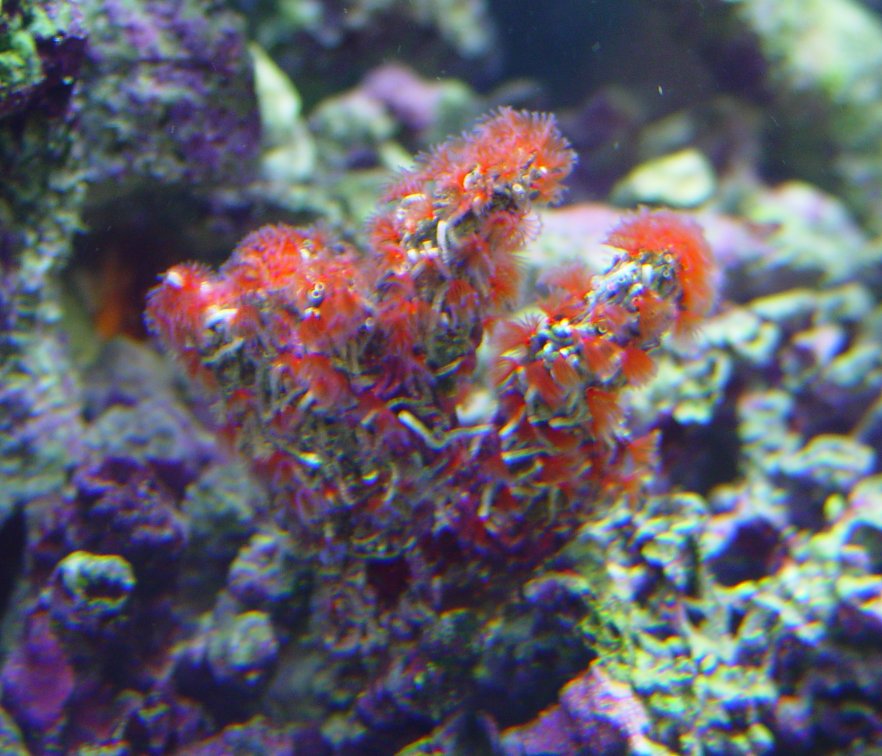
" . . . .carribean red fan worms." Are these what you are refering to? I have called them Red Cluster Duster Worms. Pretty cool, huh? We have not seen our reporducing though. ------------- Richard Alpine, UT |
Posted By: FuzzyWeasel
Date Posted: February 11 2004 at 1:29pm
|
Yeah, that's them. And I have a rock that looks to be about the same size as yours. But the suckers are all over my tank now. At first they were little white specks on the side of the glass and on EVERY surface in the tank... now those specks are either dieing off or growing big enough to be able to see the unmistakable bright red fan. It was my LFS that called them "Carribean red fan worms". I'm beginning to wonder how accurate they are on a ton of stuff. After doing my research I've noticed several things in their store that are mis-identified. Not wanting to appear as a know-it-all I don't say anything but it makes me wonder. Do you know if "Red Cluster Duster Worms" is the proper name? Or even better... know the scientific name? Fuzzy Weasel
|
Posted By: Jake Pehrson
Date Posted: February 11 2004 at 1:47pm
|
It think that the local pet store woule be correct in calling them "Carribean red fan worms", IF they came from the Carribean. They are red and "fan worms". ------------- Jake Pehrson Murray http://coralplanet.com" rel="nofollow - coralplanet.com http://utahbeeranch.com" rel="nofollow - :) |
Posted By: Richard L.
Date Posted: February 11 2004 at 2:44pm
|
According to page #138 of Sprung's Invertebrates: Filogranella species Filogranella sp. from the ------------- Richard Alpine, UT |
Posted By: rstruhs
Date Posted: February 14 2004 at 12:23am
|
Hey! I'd like to pick up some of them! Where can I? ------------- Rodney, Sandra, Jeffery, and Laura Struhs South Jordan, Utah 98th South & 40th West. (801) 282-2744 75 gallon reef 55 gallon reef 55 gallon FOWLR 20 gallon FOWLR |
Posted By: chrisslc
Date Posted: February 17 2004 at 10:19pm
|
Hey fuzzy, as for how to create pourousness (sp.?) in the aragocrete, the traditional way to "air-entrain" concrete is to use one of many admixtures for the purpose. But, most of these are detergent based and would pose a threat to a reef of course. you could try mixing in crushed ice at the last moment but the additional water from melting and the cold may effect the setting of the cement directly in contact with the ice. you could possibly grind up parafin wax, mix it in, then boil it out once the cement is set. I wouldn't think leftover wax would be a problem for the tank. I only pose these ideas because it sounds like you're willing to experiment a bit and I'd love to see if it is possible. It would go a long way towards convincing me to use aragocrete before natural rock. ------------- Murray, Utah just north of the park. "It's all the same to the clam" -Shel Silverstein |
Posted By: FuzzyWeasel
Date Posted: February 18 2004 at 1:45pm
|
Hey, thanks for the suggestions I will definitely try both. (am already planning dry ice shavings for the ice because it lasts longer and evaporates without screwing the mix up) This is the prime reason for my new tank... to experiementing with the agro. I already worked out a deal with my local plastics provider to give me all of the plastic shavings I need.... also worked out a deal with a local seafood store to allow me to pick up as many oyster shells as I want... and I live near the ocean and am going to try some natural substrate for my mix. It's going to be a slow process because I am documenting it and following a very controlled research process. The goal is to have hard fast proof in the end even if it only proves a little.
-Fuzzy Weasel |
Posted By: jfinch
Date Posted: February 18 2004 at 3:05pm
|
Why oyster shells? Don't they contain more then normal amounts of phosphates? ------------- Jon https://www.youtube.com/channel/UC6y_EzjI_ljbIwf2n5uNzTw" rel="nofollow - What I've been doing... |
Posted By: Adam Blundell
Date Posted: February 18 2004 at 3:07pm
|
As I mentioned in another post... Oyster Shells are bad.... very very bad. Adam ------------- Come to a meeting, they�re fun! |

Posted By: chrisslc
Date Posted: February 19 2004 at 7:32pm
|
hey Adam, what about the large mussel shell clusters sold as decoration in stores? Do they cause any trouble? ------------- Murray, Utah just north of the park. "It's all the same to the clam" -Shel Silverstein |
Posted By: Adam Blundell
Date Posted: February 19 2004 at 8:59pm
|
I don't know. I wouldn't try them, just to be safe, but I don't think anyone has really tried them out. Adam ------------- Come to a meeting, they�re fun! |
Posted By: Mark Peterson
Date Posted: February 19 2004 at 11:16pm
|
This may sound wacky, but the way to add porosity to aragocrete is to mix in Cheerios! When you sit the aragocrete in water to cure it the Cheeerios get soft and can be washed away on the outside. Inside they remain encased in cement or if connected to water, are slowly eaten away by worms, bacteria and Marine kids.
Other non-sugared breakfast cereals work too, but Cheerios are just the right size, shape and texture. Non-sugared cereals are recommended so that the marine kids don't get too hyper...  ------------- Reefkeeping Tips, & quick, easy setup tricks: www.utahreefs.com/forum/forum_posts.asp?TID=9244 Pay it forward - become a paid WMAS member
|
Posted By: chrisslc
Date Posted: February 20 2004 at 7:17am
|
Adam, I asked the question without mentioning that I have a large cluster hanging out in the back of my 55 that I put in when I first set it up as a FO. Mostly because I was afraid of that they might be problematic Mark, that has to be the most simple, brilliant thing I've heard in a long time... cheerios... sheer genius... seriously I'm kinda dumbstruck,it didn't even occur to me but it's perfect.... the dry ice thing might work because freezing doesn't adversely effect early set in cement, it just continues it's cure once thawed, but who wants to buy and handle dry Ice over Cheerios. You can't snack on dry ice while you work I really can't equate how valuable this forum is. All kinds of positive and negative exchange and the ability to pick the brains of some highly experienced, helpful people. I've praised it before but I like to encourage things that benefit me
------------- Murray, Utah just north of the park. "It's all the same to the clam" -Shel Silverstein |
 . It seems to be slowly dissolving
 , so I guess whatever it contains has been leaching into my system for the duration of it's existence.
 although I haven't noticed any specific ill effects I will say that I haven't had great growth in species that I have seen prosper under similar conditions as mine. but then maybe I'm just looking too hard for a scapegoat instead of buying the MH's I've been putting off
 so keep posting everybody and thanks