Reef worm id
Printed From: Utah Reefs
Category: Specialized Discussion
Forum Name: Invertebrates
Forum Description: This is the place to ask questions about invertebrates.
URL: http://www.utahreefs.com/forum/forum_posts.asp?TID=52522
Printed Date: January 11 2026 at 2:58pm
Software Version: Web Wiz Forums 12.03 - http://www.webwizforums.com
Topic: Reef worm id
Posted By: WhiteReef
Subject: Reef worm id
Date Posted: November 12 2011 at 10:49pm
|
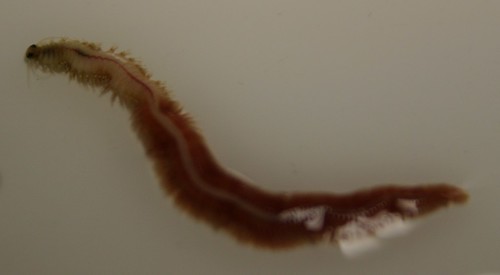
Checked out my tank tonight and found something swimming in the water column near the top. I thought it was a small missing fish in my tank, but I was able to capture it and examine it. It turns out it was a worm, but it does not look like the typical bristle worms that I have seen before over the years. Its movement in the water was not the same as when I have seen bristle worms spawn in open water. I have these two photos, so maybe someone knows what kind it is.
The top portion is white and the lower portion is red. Both are feathery all the way to the center. It has two antennia. There is a prodomenant vein running down the center that you can watch the blood pulse through it. It really looked more like a small slender fish than a worm swimming in the water. Nothing like something cool and unusual to spice up the evening. 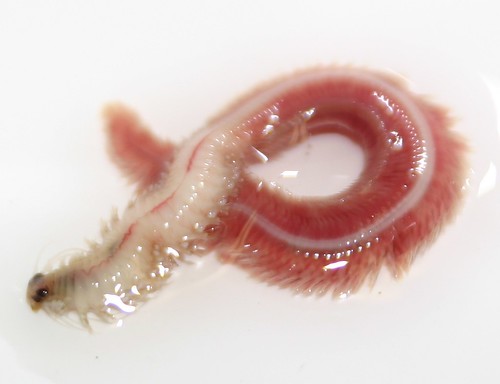
 ------------- ---------------- Richard Former 47G Column Reef, Magna 20" x 18" x 31"H |
Replies:
Posted By: bstuver
Date Posted: November 12 2011 at 11:01pm
|
Have no idea what it is but it looks nasty!! ------------- Jackie Stuver "wait these aren't the happy Hawaiians oompa doompa godly heaven on your face zoas? I dont want them then. lol!" Ksmart |
Posted By: WhiteReef
Date Posted: November 13 2011 at 8:34am
|
I added two vidoes of it swimming. The first one it gets sucked into the powerhead and survives. The second one is just where it is swimming.
Since I have not had issues related to it or that I know of, I put it back in. I just don't know if it was from the Florida LR/LS or from a frag. ------------- ---------------- Richard Former 47G Column Reef, Magna 20" x 18" x 31"H |
Posted By: lskurys
Date Posted: November 13 2011 at 10:53am
|
I have seen them in my tank also. I noticed it right after adding live florida rock. I have not noticed any problems from it and have not seen it again. ------------- 220g , large elite aquatics sump. 3 Radion Pro Gen 3 lights 3 Mp 40's |
Posted By: ptronsp
Date Posted: November 13 2011 at 11:00am
|
How big is it? It looks long. It isn't shy that's for sure! I cannot wait until someone identifies it.
------------- The only clowns I like are in my tank! |
Posted By: WhiteReef
Date Posted: November 13 2011 at 5:48pm
|
It is about 2 inches long. ------------- ---------------- Richard Former 47G Column Reef, Magna 20" x 18" x 31"H |
Posted By: 19cobra93
Date Posted: January 27 2012 at 12:13pm
| Looks like a fireworm to me. |
Posted By: Mark Peterson
Date Posted: January 27 2012 at 1:18pm
|
Nice pics. The "so called" Fireworms I have ever seen, look just like Bristleworms, but the only worm that ever seemed to be eating coral in any of my tanks, had the form of a Bristleworm, yet it was 3 times the size and drab green. It lived under a rock and I caught it with the bunched Bridal Veil trap. Unless I find something getting eaten in my tank, I don't worry about it. I've seen hundreds of different types of worms over the years but only had problems with that green one. There are something like 3000 worms related to the bristleworm. Here are some pics of some cool worms in a friends tank. This was the first time we saw them. The second time, I caught some but they disintegrated in the net. Made me think they are like a Salmon that dies and deteriorates quickly after spawning.   ------------- Reefkeeping Tips, & quick, easy setup tricks: www.utahreefs.com/forum/forum_posts.asp?TID=9244 Pay it forward - become a paid WMAS member 
|
Posted By: arthuriv
Date Posted: January 31 2012 at 10:13am
|
My guess is it is a Free
swimming Epitoke! Epitoky is a form of http://en.wikipedia.org/wiki/Reproduction" rel="nofollow - reproduction observed in http://en.wikipedia.org/wiki/Polychaete" rel="nofollow - polychaete marine worms. The worms undergo a partial or complete transformation into an epitoke, a http://en.wikipedia.org/wiki/Pelagic" rel="nofollow - pelagic http://en.wikipedia.org/wiki/Morph_%28zoology%29" rel="nofollow - morph capable of http://en.wikipedia.org/wiki/Sexual_reproduction" rel="nofollow - sexual reproduction . Often an epitoke is the posterior part of the worm, which separates from the anterior part (called the atoke); http://en.wikipedia.org/wiki/Gamete" rel="nofollow - gametes are produced inside the epitoke. The epitoke may also form by asexual http://en.wikipedia.org/wiki/Budding" rel="nofollow - budding from the posterior. There are two methods in which this can occur, epigamy and schizogamy. In epigamy, the whole worm transforms into a swarming epitoke. It rises and sheds its eggs and sperm. After reproduction, it dies. In schizogamy, the sexual forms are budded from the posterior or from the parapodia to swarm. This is effectively asexual reproduction of the epitoke. In the third form (characteristic of http://en.wikipedia.org/wiki/Nereidae" rel="nofollow - Nereidae , for example), the whole worm becomes an epitoke. This form may be accompanied by partial or full degeneracy of http://en.wikipedia.org/wiki/Digestive" rel="nofollow - digestive organs (causing the animal to die quickly) and enhancement of motor and sensory organs; in particular, whereas in its nonreproductive form the worm is a crawling animal, when it becomes an epitoke the worm develops swimming appendages, such as broad http://en.wikipedia.org/wiki/Parapodia" rel="nofollow - parapodia with paddle-shaped http://en.wikipedia.org/wiki/Chaeta" rel="nofollow - chaetae . Epitokes swim to the http://en.wikipedia.org/wiki/Plankton" rel="nofollow - plankton -rich surface region, where the gametes erupt from the body and the http://en.wikipedia.org/wiki/Larva" rel="nofollow - larvae hatch. This action is often synchronized with moon cycles, and epitokes swim in swarms. In the past it was thought that epitokes were separate species from http://en.wikipedia.org/wiki/Polychaete" rel="nofollow - polychaete marine worms. ------------- Quality Marines Aquaculturing & Captive Breeding program! Presented by Ashley & Chelsea from Reef On Thursday 6 Oct 2016 |