| Author |
 Topic Search Topic Search  Topic Options Topic Options
|
jfinch 
Guest


Joined: March 06 2003
Location: Pleasant Grove
Status: Offline
Points: 7067
|
 Post Options Post Options
 Thanks(0) Thanks(0)
 Quote Quote  Reply Reply
 Topic: Utah Rock Origins Topic: Utah Rock Origins
Posted: July 27 2004 at 10:23pm |
Being the curious guy that I am, I was equally as curious about the origins of that Utah rock as much as it's aquarium suitability. So, off and on I have searched around for more geological info (without much luck). In my looking I recently came across a frequent poster on reefcentral (boomer) who, if not a geologist, certainly knows geology. So I decided to hit him about it. Here's the thread on reefcentral. http://www.reefcentral.com/forums/showthread.php?s=&thre adid=401475. Boomer did answer many of my questions. I also emailed a professor at Kansas State U, Jack Oviatt, about this rock. If you do a search on Lake Bonneville deposits you'll see Jack's name pop up more then anyone else's. Jack was great! He confirmed Boomers comments and he's snail mailing me more in depth info on Lake Bonneville! Real nice guy. Anyway to summarize:
Long story short... the rock is Lake Bonneville Tufa
Long story... Tufa is a CaCO3 mineral deposit formed in water that is saturated in calcium and carbonates. As this saturation is pushed over the edge, CaCO3 is precipitated and formed what are for essentially stalagmites (probably the most famous are the tufa rock formations at Mono Lake, CA). This happens as a result of evaporation which concentrates the minerals and according to Dr. Oviatt, in the case of Lake Bonneville tufa, this process was helped along by algae photosynthesis. As the algae consumed the dissolved CO2, the pH in the vicinity of the algae was increased causing CaCO3 to be precipitated.
There are 4 Lake Bonneville shorelines that can be seen on the mountains around here. This tufa is found mainly on two of these shorelines, the Stansbury and Provo shorelines. About 20,000 yrs ago Lake Bonneville had a stable water level and formed the first shoreline feature called the Stansbury level. At this level the tufa is cemented to gravel (see my pictures in the reefcentral thread, I think this is where my rocks came from). The lake then rose to the highest point, the Bonneville level, until the dam broke and the lake flooded through Idaho forming the snake river gorge. The next stable level (14,000 yrs ago) was the Provo level. This level contains thick tufa deposits (I think this is where Mark is getting his current rocks from). Here's a graph showing the lake levels:

And here is a web site (I wish I would have found this a year ago) showing tufa from Lake Bonneville: http://www.geog.utah.edu/geoantiquities/Lake%20Bonneville%20 Tufa.htm
|
|
|
 |
jfinch
Guest
Joined: March 06 2003
Location: Pleasant Grove
Status: Offline
Points: 7067
|
Post Options
Thanks(0)
Quote Reply
Posted: July 27 2004 at 10:29pm |
Here's an excerpt from Jack's first email (in case I missed something in the above post):
Jon, thanks for your message. I have just returned from Utah where I was doing field work on Great Salt Lake and Lake Bonneville -- sorry to be slow to respond to your questions.
The photographs you attached to your message show that the material you have collected is tufa from Lake Bonneville. Tufa is calcium carbonate that precipitated from the waters of Lake Bonneville and is very common in the basin. In some places it is aragonitic and in other places it is calcitic (or both), and in places it cements shorezone gravel (the gravel you have called "river rock" is most likely beach gravel). The tufa head you have pictured probably formed at the bottom of the lake when it was pretty shallow at this location (most likely during the transgressive phase of the lake sometime between 25 and 15,000 years ago, depending on the elevation), and probably was aided in its precipitation by the photosynthesis of algae (which removes CO2 from the water and raises the pH, this inducing CaCO3 precipitation).
Bonneville tufa deposits vary in composition and purity -- some are
very clean and pure aragonite or calcite, some are "dirty" in that they contain lots of sediment, sand or rock fragments, and some are highly weathered. I don't know anything about fish tanks so I can't judge whether tufa would be appropriate, but I would guess that if it is clean tufa and not too weathered, that it might work well. To determine whether the tufa is aragonite or calcite would probably require analysis by X-ray diffraction (a common procedure used by geologists). Dr. Marjorie Chan in the Department of Geology and Geophysics at the U of U might be able to help you with other questions.
|
|
|
|
Jared
Guest

Joined: November 25 2002
Location: United States
Status: Offline
Points: 692
|
Post Options
Thanks(0)
Quote Reply
Posted: July 28 2004 at 5:06am |
|
Very very interesting. I guess this confirms Mark's statment that it is aragonite and not calcite.
|
|
Jared Neilsen
Lehi, Utah
|
|
rstruhs
Guest

Joined: October 18 2003
Location: Japan
Status: Offline
Points: 1003
|
Post Options
Thanks(0)
Quote Reply
Posted: July 28 2004 at 5:39am |
Wow! Nice research Jon! 
|
|
Rodney, Sandra, Jeffery, and Laura Struhs
South Jordan, Utah 98th South & 40th West.
(801) 282-2744
75 gallon reef
55 gallon reef
55 gallon FOWLR
20 gallon FOWLR
|
|
Travis
Guest

Joined: September 23 2003
Location: United States
Status: Offline
Points: 621
|
Post Options
Thanks(0)
Quote Reply
Posted: July 28 2004 at 6:34am |
|
So is the conclusion that it's fine for aquariums??
|
|
Jared
Guest
Joined: November 25 2002
Location: United States
Status: Offline
Points: 692
|
Post Options
Thanks(0)
Quote Reply
Posted: July 28 2004 at 6:44am |
 Travis wrote: Travis wrote:
So is the conclusion that it's fine for aquariums?? |
If it's not fine I think lots of people would have had a lot more problems. Many of us have been using it for years.
The real discussion has been over how beneficial it is and how it compares to store bought Live rock. Showing that it's aaragonite goes a long way IMHO to show that once properly seeded and aged it's just as good as normal live rock.
|
|
Jared Neilsen
Lehi, Utah
|
|
Mark Peterson
Paid Member


Joined: June 19 2002
Location: Murray
Status: Offline
Points: 21436
|
Post Options
Thanks(0)
Quote Reply
Posted: July 28 2004 at 7:00am |
|
Thank you Jon Finch. This is why they pay you the big bucks. I'm sure glad that I know you. Thanks for that excellent research.
I found one of those heads in areas of tubulent water last year but now I'm excited to go back and photograph it and bring back some samples. Sounds like we ought to be looking around for more and possibly better areas to collect this stuff, which is definitely good for our use, when it is clean CaCO3 with no beach rock/gravel. The Lake View Exit and the Aragonite I-80 exit a mile or so later are evidently just the beginning of the places we can find this Tufa!
|
Reefkeeping Tips, & quick, easy setup tricks:www.utahreefs.com/forum/forum_posts.asp?TID=9244 Pay it forward - become a paid WMAS member 
|
|
jfinch
Guest
Joined: March 06 2003
Location: Pleasant Grove
Status: Offline
Points: 7067
|
Post Options
Thanks(0)
Quote Reply
Posted: July 28 2004 at 7:28am |
Thanks guys. I've always had more then a passing interest in geology, so it's been fun. And I almost posted this thread in the off-topic area 'cause I don't have any more info regarding it's aquarium use...
My crude density measurements suggest that it is aragonite, but I think x-ray diffraction is probably the only way to know for sure. BUT, imo, it really doesn't matter. And I'd be more comfortable using it in a reef tank if it were calcite anyway. And Mark picked up on what this really means... there's tons of this stuff out there! If you have a GPS you would want to concentrate in the 4400 ft elevation (Stansbury level) and 4740 ft elevation (Provo level). And you want to find a spot where the lake would have been shallow, so the wasatch front mountains are probably not a good place, but sections of the west desert would be.
|
|
|
|
acerob
Guest

Joined: April 12 2004
Location: United States
Status: Offline
Points: 424
|
Post Options
Thanks(0)
Quote Reply
Posted: July 28 2004 at 10:30am |
Jon, you are amazing. It's cool to know that people do go to extreams to figure this stuff out.
|
|
Highland, UT
12g Nano
90g Reef
|
|
Carl
Guest

Joined: September 17 2003
Location: United States
Status: Offline
Points: 1346
|
Post Options
Thanks(0)
Quote Reply
Posted: July 28 2004 at 2:24pm |
Jon, very good information I think. Unfortunately, as I read the RC posts all I heard was BLAH, BLAH, BLAH, GARBLE, GARBLE, GARBLE... I guess my brain isn't developed enough to understand that stuff. 
|
|
In Syracuse
"I believe that forgiving them is God's function. Our job is simply to arrange the meeting." - Gen. H. Norman Schwarzkopf
|
|
rfoote
Guest

Joined: February 24 2003
Location: United States
Status: Offline
Points: 1926
|
Post Options
Thanks(0)
Quote Reply
Posted: July 28 2004 at 3:25pm |
WOW - now Jon's head has got to be about the size of a watermelon! I wanna be like Jon!
Just kidding Jon - Great work!
|
|
jfinch
Guest
Joined: March 06 2003
Location: Pleasant Grove
Status: Offline
Points: 7067
|
Post Options
Thanks(0)
Quote Reply
Posted: April 20 2007 at 11:09pm |
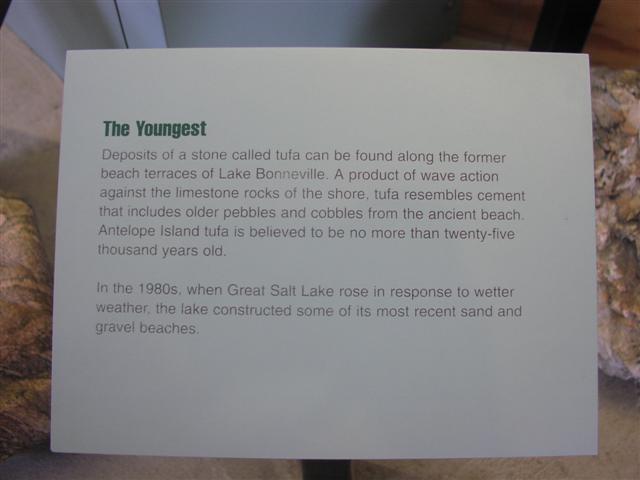
Geez, I could have saved myself a lot of time researching this stuff if I would have just made a visit out to Antelope Island. I was out there a couple days ago with the family. We stopped at the visitor center and they had a nice display of, among other things, the geology of the lake.
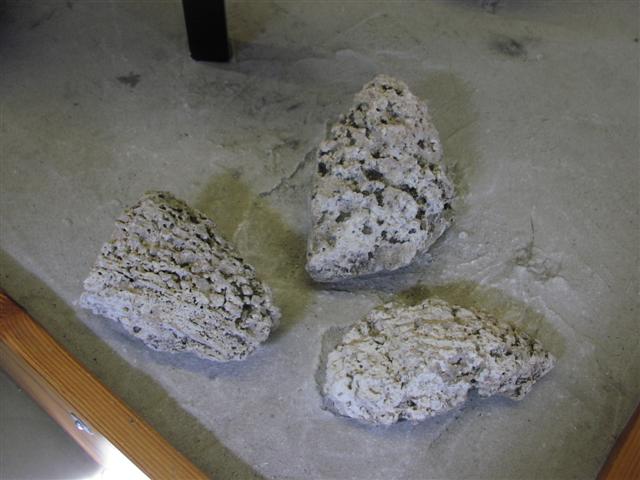
And the examples:
By the way, there's tufa all over Antelope Island and even a beach full of oolitic sand.
Edited by jfinch - April 20 2007 at 11:10pm
|
|
|
|
Mike Savage
Guest

Joined: July 15 2005
Location: Murray
Status: Offline
Points: 19173
|
Post Options
Thanks(0)
Quote Reply
Posted: April 20 2007 at 11:45pm |
Great work! 
|
|
|
|
Cecil
Guest

Joined: November 23 2006
Location: United States
Status: Offline
Points: 128
|
Post Options
Thanks(0)
Quote Reply
Posted: April 21 2007 at 8:37am |
Last October I went to the Stansbury Island location to get utah sand and rock. Found lots of rock, most of it grapefruit size some bigger, lots smaller.
Last weekend I went on a scout trip with my son to Antelope Island. We stayed on a beach that has utah sand so pure I could hardly belive it. The next day driving along the road I saw some rock that looked like utah rock. Getting out of the car I found myself standing on a hill of utah tufa rock with many pieces basketball size and bigger.
The sad part is that Antelope Island is a state park and I am sure it is unlawful to remove it.
If anyone knows how we could get it and not break the law, I know the spot.
|
|
fj40fax
Guest

Joined: November 04 2004
Location: United States
Status: Offline
Points: 1261
|
Post Options
Thanks(0)
Quote Reply
Posted: April 21 2007 at 11:30am |
|
Next time I go out by the nutty putty caves I am going to see if I can
find some areas that could be closer for us UT countyites.
A quick look on Google Earth says that the shore of Utah lake is about
4500ft, just above/at the stansbury level, but the Provo level should
be a bit easier to find at 4750-4850 ft. As a reference, where I-15 crosses poin of the mountain is about 4800 ft.
Edited by fj40fax - April 21 2007 at 11:47am
|
|
Fax 318-3632
90g 2x250W 14kK MH
Sump, Fuge, G3, UV, O3, ACIII
Pleasant Grove, UT Across State Street from the Purple Turtle
Adjustments and Massages for Frags!
|
|
fj40fax
Guest
Joined: November 04 2004
Location: United States
Status: Offline
Points: 1261
|
Post Options
Thanks(0)
Quote Reply
Posted: April 21 2007 at 12:08pm |
|
East of Lake Shore drive in Tooele up on that mountain may be a good place also, anybody want to take a look?
|
|
Fax 318-3632
90g 2x250W 14kK MH
Sump, Fuge, G3, UV, O3, ACIII
Pleasant Grove, UT Across State Street from the Purple Turtle
Adjustments and Massages for Frags!
|
|
faviasteve
Guest

Joined: June 30 2004
Location: Seychelles
Status: Offline
Points: 455
|
Post Options
Thanks(0)
Quote Reply
Posted: April 21 2007 at 2:08pm |
Tufa can also be formed from a warm spring. Utah has these deposits as well. I don't know how porous spring tufa is, but I'm sure Jon could check it out.
I graduated in geology so here's what I can remember about the Utah warm-fault-spring tufa deposits.
The Wasatch Fault isn't one continuous crack (that occasionally moves) in the Earth's crust. It's actually many smaller cracks that are almost parallel. The mountains go up and the valleys go down. The almost aligned but parallel fault segments make the "Wasatch Mountain Front" have a stepped look when viewed from above. You can see the stepped effect when you drive north or south from Salt Lake on I-15. The Brigham City/Willard fault segment is farther west. The Odgen segment jogs east from there. The Farmington/Centerville/Bountiful segments is west of Odgen and the Salt Lake segment is east again. At the ends of these fault segments (for some reason I never understood) warms springs come to the surface and the supersaturated water cools and deposits tufa.
One of these springs exists in an industrial area just east of Highway 89 in North Salt Lake- lots of big trucks and equipment storage. I went on a field trip there with USU about 10 years ago. On the hill above the spring there are large blocks of tufa. I've thought about trying to find a way onto that hill and looking around, but never have.
Steve
Edited by faviasteve - April 21 2007 at 2:12pm
|
|
Steve Burton
Logan, Utah
|
|
peregrinus
Guest

Joined: July 06 2003
Location: Clearfield
Status: Offline
Points: 645
|
Post Options
Thanks(0)
Quote Reply
Posted: April 23 2007 at 10:34am |
|
I was going to say that these issome info on the island buthe already found it.. i was out riding my bike on the island and its all over the place out there..
|
|
In Clearfield
Quantum mechanics the dreams stuff is made of.
|
|
Guests
Guest Group

Pet Store
|
Post Options
Thanks(0)
Quote Reply
Posted: April 23 2007 at 12:05pm |
|
Should Utah rocks be replaced in our tanks once in a while?
|
|
jfinch
Guest
Joined: March 06 2003
Location: Pleasant Grove
Status: Offline
Points: 7067
|
Post Options
Thanks(0)
Quote Reply
Posted: April 23 2007 at 12:23pm |
Should Utah rocks be replaced in our tanks once in a while?
No, I don't think so. Not any more often then you replace live rock.
|
|
|
|